
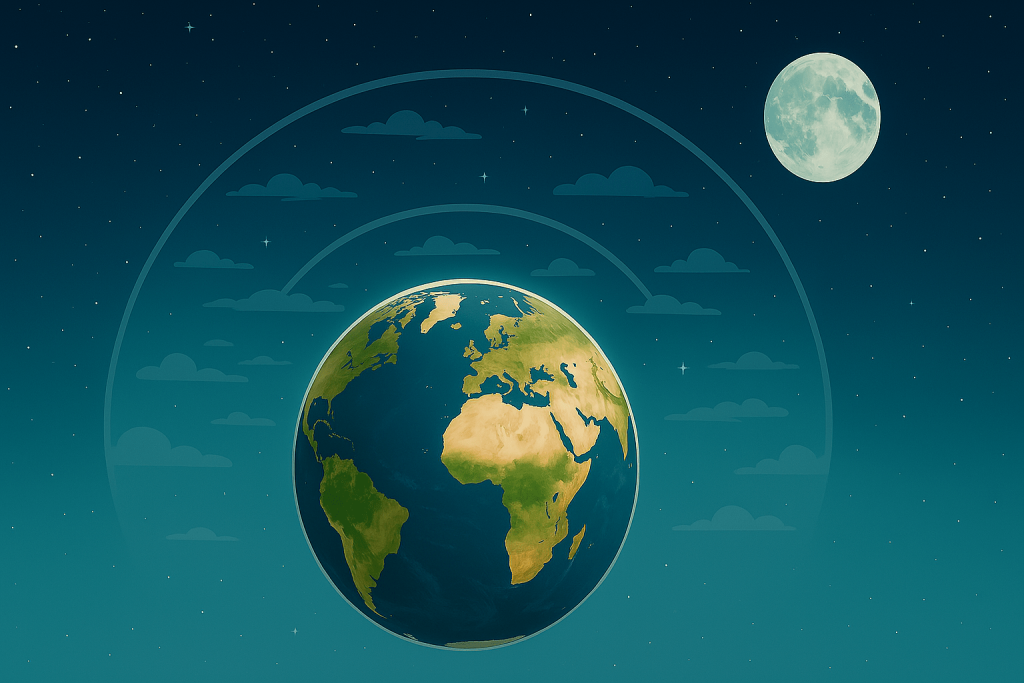
Firmament Myth Debunked: The Evidence, Explained
Last updated: September 30, 2026.
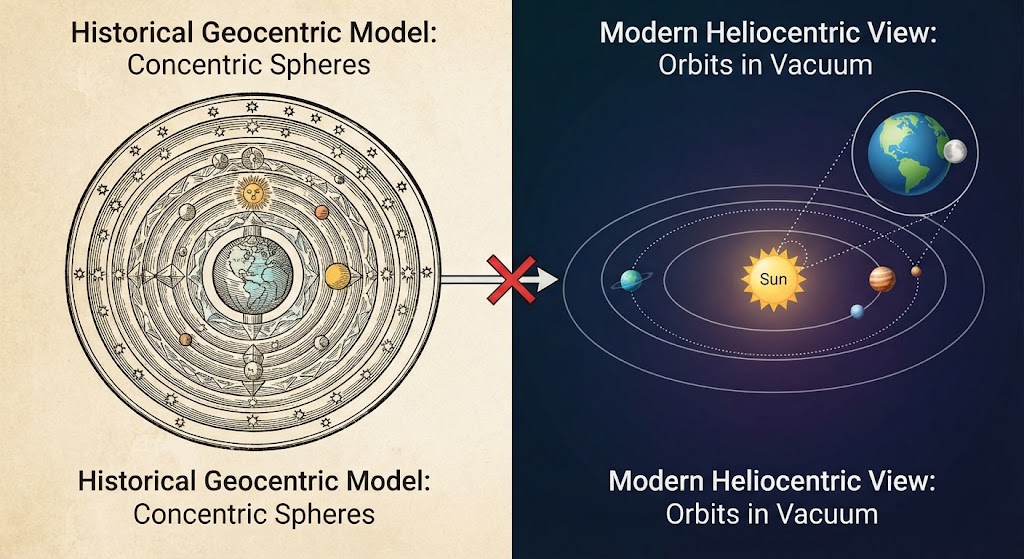
For centuries, some cultures pictured the sky as a solid dome — a “firmament” — separating Earth from the heavens above. It’s an understandable idea for anyone looking up with the naked eye. But the firmament myth hasn’t survived contact with modern instruments, spacecraft, and physics. Below is a detailed look at the evidence, from multiple independent scientific fields, that answers the question “is the firmament real?” once and for all.
Is the Firmament Real? What the Evidence Shows
Short answer: no. Human spaceflight, satellite orbits, and decades of astronomical observation all confirm there is no physical dome enclosing Earth. Here’s the evidence broken down by field.
Evidence From Space Exploration
Human spaceflight. Since Yuri Gagarin’s first orbital flight in 1961, more than 700 people have traveled to space, and 24 astronauts — the Apollo crews between 1968 and 1972 — traveled far enough to leave Earth orbit entirely and see the whole planet as a sphere hanging in space. The Apollo 8 crew’s 1968 “Earthrise” photograph, taken from lunar orbit roughly 240,000 miles away, shows Earth as an unobstructed globe with nothing surrounding it. If a solid dome enclosed the planet, it would have been physically impossible to pass through it, let alone photograph Earth from beyond it.
Satellite orbits. As of mid-2026 there are more than 15,000 active satellites in orbit, ranging from a few hundred kilometers up (low Earth orbit, where the ISS and Starlink satellites fly) to roughly 36,000 km up (geostationary orbit, home to most communications and weather satellites). These orbits are maintained purely by the balance between gravity and orbital velocity, calculated with Newtonian mechanics verified to extraordinary precision. GPS satellites must also correct for relativistic time dilation predicted by Einstein’s general relativity — a correction that works perfectly and that a solid intervening structure would disrupt.
Interplanetary and interstellar probes. Spacecraft have flown past or landed on every planet in the solar system. Voyager 1, launched in 1977, crossed the heliopause — the boundary where the Sun’s solar wind gives way to interstellar space — in 2012, and is now more than 15 billion miles from Earth, still transmitting data. New Horizons flew past Pluto in 2015 and the Kuiper Belt object Arrokoth in 2019. None of these missions encountered any physical obstruction on the way out of the solar system.
Observational Evidence That Debunks the Firmament Myth
Telescopes across the spectrum. Optical telescopes like Hubble, along with radio, X-ray, and infrared observatories, routinely image galaxies billions of light-years away — meaning their light has been traveling toward us for billions of years, through the same line of sight, without deflection or blockage. The James Webb Space Telescope has photographed galaxies from within a few hundred million years of the Big Bang, over 13 billion light-years distant.
Spectroscopy. When astronomers pass starlight through a spectrograph, they see absorption and emission lines that match the known chemical signatures of hydrogen, helium, and other elements exactly as predicted by laboratory physics — even for light that has traveled across most of the observable universe. Any solid intervening shell would scatter, absorb, or otherwise alter that light in detectable ways; we don’t see that.
Stellar parallax. As Earth orbits the Sun, nearby stars appear to shift very slightly against the background of more distant stars — the same effect you see when you hold up a finger and close one eye, then the other. The European Space Agency’s Gaia mission has measured parallax for roughly 2 billion stars, some more than 30,000 light-years away, letting astronomers calculate precise 3D positions throughout a large portion of our galaxy. These measurements only make sense in a universe extending far past any proposed dome.
Atmospheric and Near-Earth Data
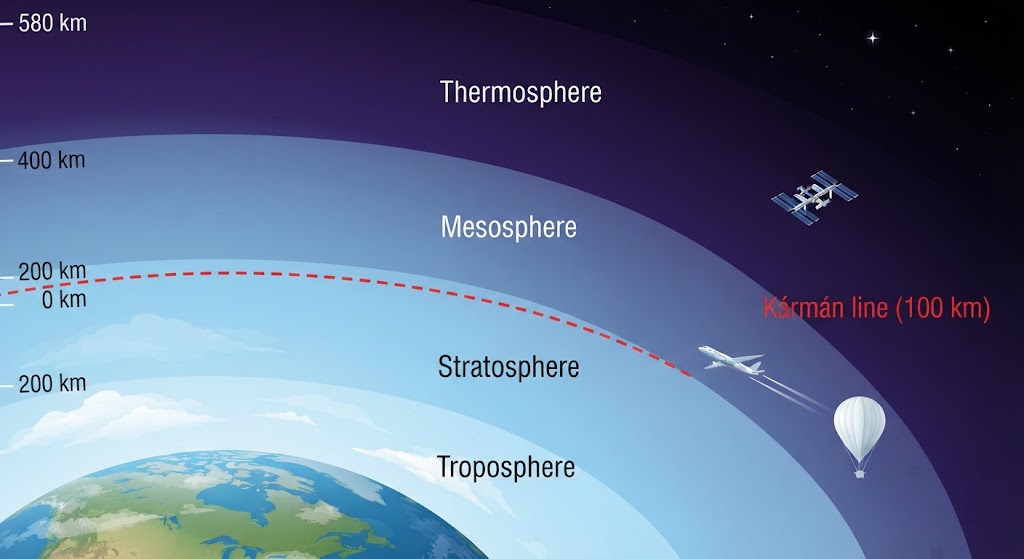
No boundary in the atmosphere. Earth’s atmosphere doesn’t end at a wall — it thins out gradually. The troposphere gives way to the stratosphere around 12 km up, the mesosphere around 50 km, and the thermosphere extends to roughly 700–1,000 km before merging into the exosphere, which fades gradually into the near-vacuum of space. The Kármán line, at 100 km, is used as a conventional (not physical) boundary of space simply because aerodynamic flight becomes impractical there — not because anything solid exists at that altitude.
Auroras. The Northern and Southern Lights occur when charged particles from the solar wind are funneled by Earth’s magnetic field into the upper atmosphere, where they collide with oxygen and nitrogen atoms and cause them to glow. A solid firmament would block this interaction entirely, yet auroras are observed regularly and have been photographed from orbit by astronauts looking down at them from above.
Meteors, meteoroids, and comets. Roughly 48 tons of meteoritic material enters Earth’s atmosphere every day, mostly burning up as visible meteors between about 75 and 100 km altitude. Larger objects occasionally survive as meteorites, like the Chelyabinsk meteor that exploded over Russia in 2013 at roughly 30 km altitude, releasing energy equivalent to about 500 kilotons of TNT. This material arrives from interplanetary space and interacts with the atmosphere in ways fully explained by orbital mechanics and atmospheric friction.
Gravity, Orbital Mechanics, and Light
Gravitational consistency. Planetary orbits, moon orbits, comet trajectories, and spacecraft trajectories are all predicted with extreme precision using Newtonian gravity (refined by general relativity for the most precise cases, like Mercury’s orbit). A massive solid structure surrounding the solar system would exert its own gravitational influence and would show up as an unexplained perturbation in these orbits. No such anomaly has ever been detected in over three centuries of precision astronomy.
The Doppler effect and redshift. Light from galaxies moving away from us is stretched to longer, redder wavelengths — the same principle behind the change in pitch of a passing siren. This redshift increases with distance in a well-established relationship (originally described by Edwin Hubble in 1929), and it’s the basis for measuring the universe’s expansion. That relationship holds smoothly out to the most distant galaxies we can observe, with no discontinuity that would indicate light bouncing off, or passing through, an enclosing shell.
The Bottom Line on the Firmament Myth
Independent lines of evidence — human spaceflight, tens of thousands of working satellites, interplanetary and interstellar probes, telescopic and spectroscopic astronomy, atmospheric science, and the mathematics of gravity and light — all point to the same conclusion: there is no physical dome enclosing Earth. Each field arrived at that conclusion separately, using different instruments and methods, and they all agree. That kind of convergent evidence, rather than any single “gotcha” observation, is what makes the case as strong as it is.
The Firmament Myth Debunked: Science vs. Reality FAQ
What is the firmament myth?
The firmament myth is the ancient idea that the sky is a solid dome enclosing Earth, separating our world from the heavens above. It arose from naked-eye observation in cultures that had no telescopes, spacecraft, or modern physics to test it. Multiple independent scientific fields — from orbital mechanics to telescopic astronomy — have since disproven it conclusively.
Is the firmament real?
No. Human spaceflight, satellite orbits, and decades of astronomical observation confirm there is no physical dome enclosing Earth. Since Yuri Gagarin’s first orbital flight in 1961, more than 700 people have traveled to space without encountering any barrier. The Apollo 8 crew’s 1968 “Earthrise” photograph shows Earth as an unobstructed globe with nothing surrounding it.
Did astronauts ever encounter a barrier or dome in space?
No. Astronauts — including the 24 Apollo crew members who traveled far enough to leave Earth orbit entirely — passed through the region where a firmament was imagined to exist without encountering any physical structure. If a solid dome enclosed the planet, passing through it would have been physically impossible, let alone photographing Earth from beyond it.
How do satellites disprove the firmament myth?
More than 15,000 active satellites maintain stable orbits governed purely by the balance between gravity and orbital velocity, which would be impossible if a solid barrier surrounded the planet. GPS satellites even apply corrections for relativistic time dilation predicted by Einstein’s general relativity — corrections that work perfectly and that a solid intervening structure would disrupt. Follow real satellite missions on our Space Launch Schedule.
What did Voyager 1 find beyond the solar system?
Voyager 1, launched in 1977, crossed the heliopause — the boundary where the Sun’s solar wind gives way to interstellar space — in 2012, encountering no physical obstruction. Now more than 15 billion miles from Earth and still transmitting data, it is the most distant human-made object ever. New Horizons likewise flew past Pluto in 2015 and Arrokoth in 2019 with a clear path out of the solar system.