
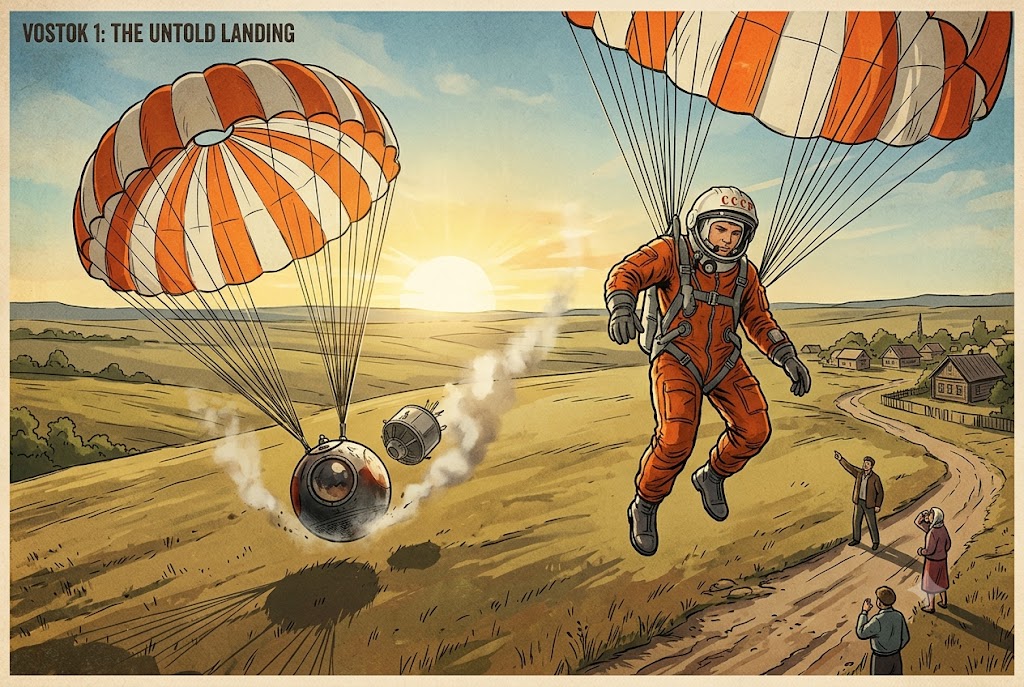
The Untold Story: Why Yuri Gagarin Didn’t Land Inside His Spacecraft
Every space enthusiast knows the date: April 12, 1961. That morning, Soviet cosmonaut Yuri Gagarin climbed into Vostok 1, rode a rocket into history, and became the first human to orbit Earth. His flight lasted 108 minutes, a single loop around the planet that changed everything.
But here’s the part that was left out of the history books for a decade: Yuri Gagarin never actually landed inside his spacecraft.
The record stands, and it’s official. However, the full story reveals how Soviet engineering realities, international aviation rules, and a deliberate omission kept that record intact. For launch schedule enthusiasts and space history buffs, it’s a fascinating chapter that still shapes how we define human spaceflight achievements today.
The 108-Minute Flight That Redefined History
At 9:07 AM Moscow time, Gagarin launched from Baikonur Cosmodrome (now in Kazakhstan). Vostok 1 reached orbit, completing one full circuit of Earth at altitudes reaching 327 kilometers. After 108 minutes, the spacecraft reentered the atmosphere over Soviet territory.
What was not reported for nearly a decade: Gagarin ejected from the capsule at roughly 7,000 meters altitude and parachuted to Earth separately. The Vostok 1 capsule descended on its own parachute nearby—empty.
Why the secrecy? The answer lies in an obscure aviation rule.
The FAI Rule That Almost Cost Gagarin His Record
The Fédération Aéronautique Internationale (FAI), the international body that certifies aviation and spaceflight records, had a longstanding rule: for a flight to qualify as an official record, the pilot must land inside their craft. This made sense for aircraft—no one wanted to encourage pilots to fly planes that couldn’t get them home safely.
When the first human spaceflights were being planned, the FAI extended this rule to spaceflight without fully considering the engineering challenges.
Why Gagarin Couldn’t Land Inside Vostok 1
According to Cathleen Lewis, curator at the Smithsonian’s National Air and Space Museum:
“Soviet engineers had not yet perfected a braking system that would slow the craft sufficiently for a human to survive impact.”
Vostok 1’s spherical reentry capsule was designed to fall on a ballistic trajectory—fast and hard. The solution was ejection: Gagarin would bail out at altitude while the capsule descended separately. The plan was never for him to be inside when it hit the ground.
The Cover-Up That Lasted a Decade
When Soviet officials filed mission documentation with the FAI, they omitted the ejection entirely. The official records implied Gagarin had landed with the craft. At press conferences, Gagarin maintained this version.
As Lewis notes: “Soviet engineers had not discussed this shortcoming with Soviet delegates to the FAI prior to his flight. They prepared their documents for the FAI, omitting this fact.”
The Cover Unravels
Just four months later, Gherman Titov flew Vostok 2—and honestly described his own landing. He had ejected too. This put the FAI in an awkward position: if the rule was disqualifying, it applied retroactively to Gagarin.
A special session of FAI delegates convened to examine both records.
Their conclusion: The great technical achievement was not how a cosmonaut landed, but the successful launch, orbit, and safe return of a living human being. Both records were upheld. The FAI revised its rules to acknowledge that the Vostok ejection design was a deliberate engineering choice—not an evasion.
When Did the Truth Finally Come Out?
The Soviet Union made no official admission of Gagarin’s ejection until 1971—a full decade after the flight, and three years after Gagarin died in a training-jet crash in 1968.
By then, as Lewis wrote, “the concept that the first cosmonauts had to land inside their spacecraft is a faded artifact of the transition from aviation to spaceflight.”
Gagarin’s Own Account
Gagarin himself told the story of his landing with characteristic calm. As reported by the Planetary Society, he recalled:
“When they saw me in my space suit, they started to back away in fear. I told them, don’t be afraid, I am a Soviet citizen like you, who has descended from space and I must find a telephone to call Moscow!”
A local woman and her granddaughter were watching as the first human spacefarer parachuted into a field—and immediately asked for a phone.
The Legacy: A Record That Changed the Rules
Today, the FAI awards the Gagarin Gold Medal annually for the most significant spaceflight achievement of the year—named for a man whose claim to the record required a rule change to stand.
Upcoming Launches & Space History Events
Planning to follow modern spaceflight history as it happens? Check our Space Launch Schedule for upcoming missions.
FAQ: Gagarin’s Vostok 1 Flight
Did Gagarin’s ejection affect his record?
No. The FAI later revised its rules to count the flight as valid. The official record stands.
Why didn’t Soviet officials disclose the ejection?
They feared that admitting Gagarin didn’t land inside the capsule might disqualify the flight under FAI rules.
When was the truth revealed?
The Soviet Union officially admitted the ejection in 1971—though Titov’s honest account in 1961 had already forced the FAI to reconsider.
Could modern astronauts eject from spacecraft?
Modern crewed spacecraft (such as SpaceX’s Crew Dragon and Boeing’s Starliner) are designed to land with the crew inside. Ejection systems today are used primarily for launch escape, not landing.