
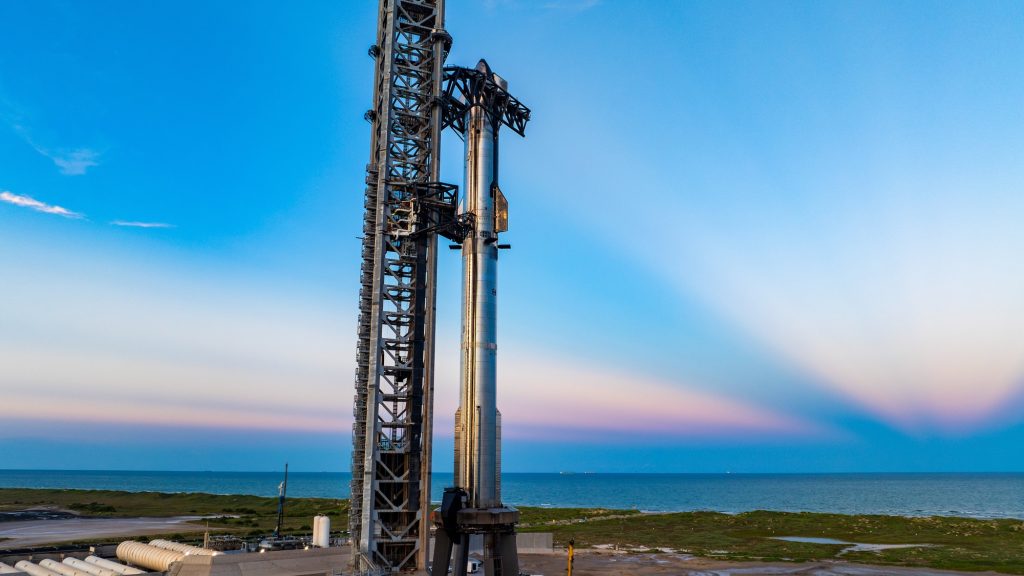
SpaceX Starship Program Status 2026: Test Flights, Progress & What’s Next
SpaceX’s Starship is the largest and most powerful launch vehicle ever flown — a fully reusable two-stage system designed to carry crew and cargo to Earth orbit, the Moon, Mars, and beyond. On September 28, 2026, Starship reached Earth orbit for the first time and deployed 26 operational Starlink satellites, a milestone that marks the program’s shift from experimental testing toward operational service.
This page tracks the complete Starship test flight history, the current Starship V3 vehicle, and what’s next for the program.
Starship V3: the current vehicle at a glance
| Spec | Detail |
|---|---|
| Height | 124.4 m (408 ft) — the tallest rocket ever flown |
| Diameter | 9 m (30 ft) |
| Booster Engines | 33 Raptor 3 (~18 million pounds of liftoff thrust) |
| Ship Engines | 6 Raptor 3 |
| Payload to LEO | More than 100 metric tons (reusable configuration) |
| Design | Fully reusable Super Heavy booster + Starship upper stage, with propellant-transfer docking ports for on-orbit refueling |
| Crew Capacity | Up to ~100 people per flight (aspirational) |
The main technical hurdle right now is Raptor 3 engine reliability: engine failures affected Flights 12 and 14, and Flight 13 suffered the program’s first post-ignition full-stack abort at T-0 when four engines failed to start.
Latest Starship launch: Flight 14 reaches orbit
September 28, 2026 — Starship lifted off from Starbase, Texas at 8:49 a.m. ET. One of the ship’s six Raptor engines shut down during ascent, but flight controllers pressed on and the ship completed its orbital insertion burn, reaching orbit (~275 km) around 9:15 a.m. ET. “Starship is orbital,” mission control announced — the first time the vehicle has achieved it.
All 26 operational Starlink V3 satellites were deployed and, according to SpaceX, all were contacted and are operating normally. The mission had been planned as a ~10-hour, six-orbit flight, but SpaceX brought the ship home early after about three hours — the company gave no technical reason, though Elon Musk has said recently the company is being “extremely cautious” about debris risk. The ship made a controlled splashdown in the Pacific north of Hawaii at 11:57 a.m. ET, tipping over and breaking apart on water contact, an outcome SpaceX expected.
The Super Heavy booster lost one engine shortly after liftoff and made a soft splashdown in the Gulf of Mexico. No catch was attempted.
Starship test flight history
| Flight | Date | Outcome |
|---|---|---|
| Flight 1 | Apr 20, 2023 | Failure — multiple engine failures, no stage separation; vehicle destroyed ~4 min in |
| Flight 2 | Nov 18, 2023 | Partial — first successful hot staging; booster exploded; ship lost ~8 min in |
| Flight 3 | Mar 14, 2024 | Partial — ship reached space; booster lost on landing burn; ship lost on reentry |
| Flight 4 | Jun 6, 2024 | Success — booster soft splashdown; ship survived reentry, controlled ocean splashdown |
| Flight 5 | Oct 13, 2024 | Success — first booster catch by the launch tower’s mechanical arms |
| Flight 6 | Nov 19, 2024 | Success — booster catch aborted to ocean splashdown; ship demonstrated in-space engine relight |
| Flight 7 | Jan 16, 2025 | Booster caught; ship lost over the Atlantic (first Block 2 flight) |
| Flight 8 | Mar 6, 2025 | Booster caught (3rd catch); ship broke apart over the Atlantic |
| Flight 9 | May 27, 2025 | First Super Heavy reflight — booster broke up on reentry; ship reached space but lost attitude control |
| Flight 10 | Aug 26, 2025 | Success — first clean deployment of 8 Starlink simulator satellites |
| Flight 11 | Oct 13, 2025 | Success — final Block 2 flight; 8 Starlink sims deployed, engine relight demonstrated |
| Flight 12 | May 22, 2026 | Partial — Starship V3 debut from new Pad 2; 20 sims + 2 Starlink V3 sats deployed; booster lost (FAA mishap investigation) |
| Flight 13 | Jul 24, 2026 | Success — first operational Starlink V3 satellites deployed (20) |
| Flight 14 | Sep 28, 2026 | First orbital flight — 26 operational Starlink V3 satellites deployed |
| Flight 15 | Dec 2026 (projected) | Planned — first attempt at catching the ship with the launch tower |
| SpaceX HLS LEO Demo | Jun 2027 (projected) | Planned — uncrewed HLS pathfinder demo in low Earth orbit for NASA’s Artemis program |
Flights 1-6 used Block 1 vehicles, flights 7-11 used Block 2, and flights 12-14 fly the current Block 3 (V3) design.
Booster catches and the road to full reusability
SpaceX has caught the Super Heavy booster with the launch tower’s “chopstick” arms three times (Flights 5, 7, and 8). A ship catch — recovering the upper stage with the tower — has never been attempted. Musk has said Flight 15 will be the attempt, possibly trying to catch both stages.
Starlink launches on Starship have begun
Starship is now flying real payloads. Flight 12 carried 20 Starlink simulators plus 2 modified Starlink V3 units, Flight 13 deployed the first 20 operational V3 satellites (on a suborbital trajectory), and Flight 14 placed 26 operational V3 satellites into orbit — adding roughly 26 terabits per second of capacity. The V3 satellites are too large to launch on Falcon 9, making Starship the only vehicle that can build out SpaceX’s planned constellation. For more on the network itself, see our overview of SpaceX’s Starlink mission.
Where Starship launches from
All 2026 flights have launched from the new Pad 2 at Starbase, Texas (three launches this year), while Pad 1 is being rebuilt. In Florida, the FAA granted environmental approval for Starship operations at LC-39A (up to 44 launches per year), though SpaceX still needs a flight license; the first Florida Starship flight is targeted for late 2026 or early 2027. Two additional pads at SLC-37 were approved in December 2025. Planning a trip to the Space Coast? See our Florida rocket launch viewing guide.
Starship and NASA’s Artemis program
NASA has restructured its Moon plans, and the old “Artemis III lands in 2027” framing is outdated:
| Mission | Date | Details |
|---|---|---|
| Artemis I | Nov 16, 2022 | Uncrewed test flight — SLS and Orion looped the Moon for 25.5 days and splashed down Dec 11, 2022 |
| Artemis II | Apr 2026 | First crewed mission beyond Earth orbit since Apollo 17 — four astronauts flew around the Moon without landing |
| Artemis III | Late 2027 | Crewed demonstration in low Earth orbit — Orion will test rendezvous and docking with the Starship and Blue Origin landers; no lunar landing |
| Artemis IV | Early 2028 | Target for the first crewed Artemis lunar landing |
Starship serves as the Human Landing System (HLS). Its first HLS test flight — the uncrewed HLS LEO Demo pathfinder in low Earth orbit — is targeted for June 2027 from LC-39A (date still TBD), ahead of the uncrewed lunar landing demonstration. The key capability it depends on — orbital propellant transfer — has never been demonstrated. Each lunar mission will require roughly 15 Starship tanker flights to refuel the lander.
Starship to Mars: where the timeline stands
Musk’s Mars dates have slipped repeatedly and should be treated as aspirational. The late-2026 transfer window will be missed — no Mars-bound hardware has been announced. Musk’s latest guidance points to an uncrewed attempt in the 2028/2029 window at the earliest, calling 2029 “most likely.”
What’s next for Starship
- Flight 15 — planned first attempt at catching the ship with the launch tower, targeted for December 2026 from Starbase. The launch page still lists the date and time as TBD, so this remains provisional.
- First Florida Starship flight — no dedicated launch page or date on the site’s schedule yet; SpaceX still needs a flight license for LC-39A.
- SpaceX HLS LEO Demo — the uncrewed HLS pathfinder demonstration in low Earth orbit for NASA’s Artemis program, targeted for June 2027 from LC-39A. The launch page still lists the date and time as TBD, so this remains provisional.
- Orbital propellant transfer demo — no dedicated launch page on the site’s schedule yet; the HLS LEO Demo above is the closest scheduled HLS test flight. Required before any Moon landing.
- Rapid reusability — SpaceX’s cadence goal is 1-2 flights per month soon, eventually far higher. This is a program goal, not a flight, so there is no launch page for it.
Starship FAQ
How many Starship test flights have there been?
Fourteen, as of September 2026 — six with Block 1 vehicles (2023-2024), five with Block 2 (2025), and three with the current Block 3/V3 design (2026).
Has Starship reached orbit?
Yes. Flight 14 on September 28, 2026 was the first Starship flight to reach Earth orbit, where it deployed 26 operational Starlink satellites.
Has SpaceX caught Starship with the launch tower?
The Super Heavy booster has been caught three times (Flights 5, 7, and 8). The ship itself has never been caught — that attempt is planned for Flight 15.
What is Starship V3?
The third and current Starship generation, which debuted in May 2026. It stands 124.4 m tall, uses 33 Raptor 3 engines, and can carry more than 100 metric tons to orbit in reusable configuration.
Will Starship land astronauts on the Moon?
Yes — Starship is NASA’s Human Landing System for Artemis. The first crewed landing is now targeted for Artemis IV in early 2028, after an uncrewed Starship lunar demo.
When will Starship go to Mars?
There is no firm date. SpaceX will miss the late-2026 window; Musk has pointed to 2029 as most likely for a first uncrewed attempt.
Where can I watch a Starship launch?
Starship currently launches from Starbase, Texas, with Florida launches from LC-39A expected to begin as early as late 2026. See our Florida launch viewing guide and space tourist travel guide when planning a trip.