
Starship vs SLS vs New Glenn: The Giant Rockets Compared
Last updated: October 7, 2026.
Three giant rockets now dominate the heavy-lift conversation: SpaceX’s Starship, NASA’s Space Launch System (SLS), and Blue Origin’s New Glenn. All three stand around 100 meters tall or more. All three can throw serious weight into orbit. But they were built on completely different philosophies, and they are at very different points in their careers. Here is how the big three actually compare.
Side-by-Side Rocket Specs
| Starship (SpaceX) | SLS Block 1 (NASA) | New Glenn (Blue Origin) | |
|---|---|---|---|
| Height | 123 m (400 ft) | 98 m (322 ft) | 98 m (320 ft) |
| Diameter | 9 m | 8.4 m (core) | 7 m |
| Liftoff thrust | ~74,400 kN | ~39,000 kN | ~17,100 kN |
| Payload to low Earth orbit | 100 to 150 tons (target) | 95 tons | 45 tons |
| Propellant | Methane + liquid oxygen | Hydrogen core + solid boosters | Methane + liquid oxygen |
| Reusability | Fully reusable (goal) | Expendable | First stage reusable |
| Flights to date | 14 test flights | 2 | 3 |
| Cost per launch | Not disclosed; designed to be low | About $2 billion | Not disclosed |
| Moon program role | Lunar lander for Artemis | Launches the Orion crew | Launches the Blue Moon lander |
Starship: The Biggest and the Boldest
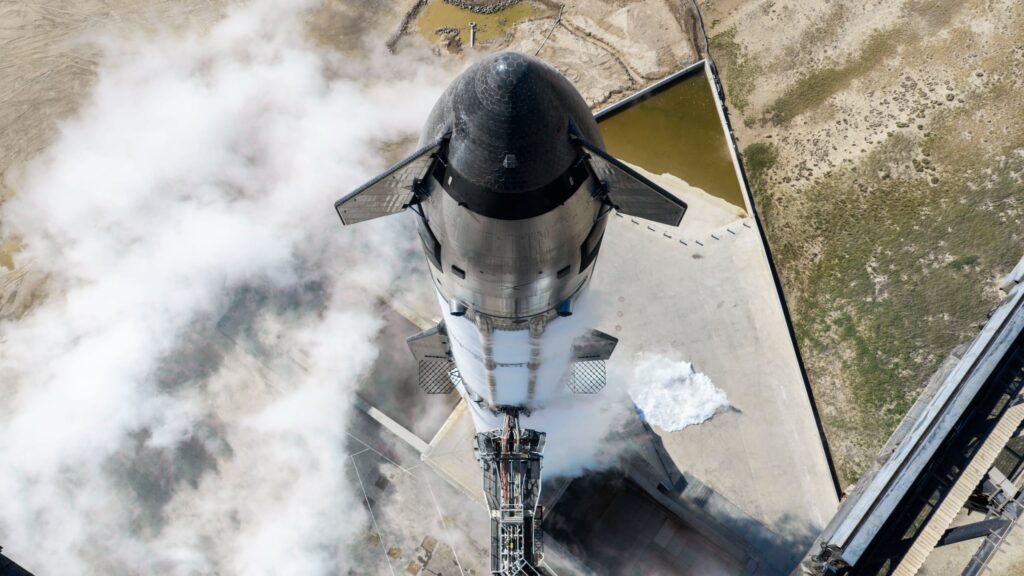
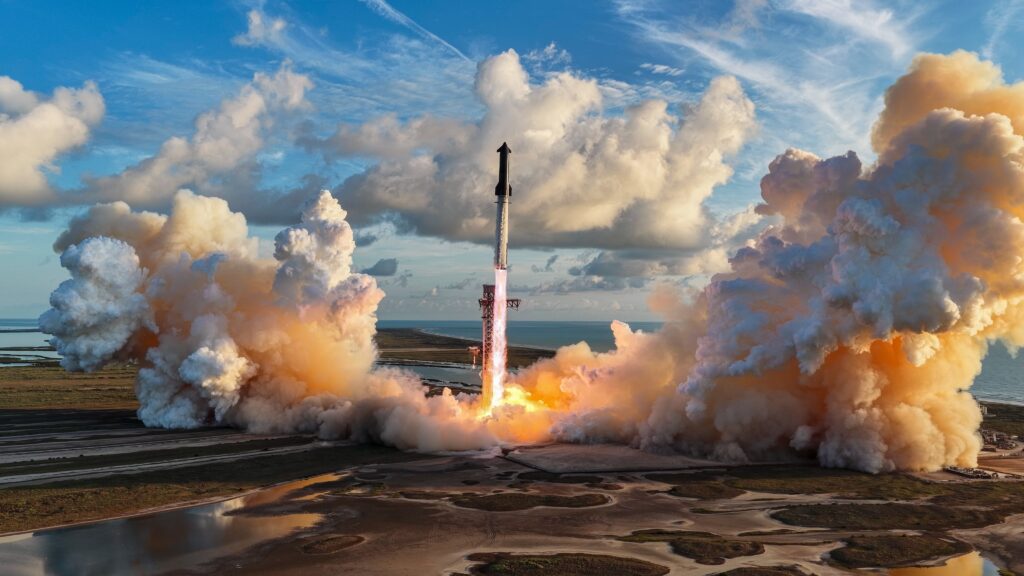
Starship is the largest rocket ever flown, a 123-meter two-stage monster powered by 33 Raptor engines on its Super Heavy booster. At liftoff, it produces roughly twice the thrust of SLS, and SpaceX intends to recover and refly both stages, catching the booster back at the launch tower. That full reusability is the whole bet: if it works, launch costs collapse and Mars stops being a fantasy.
The keyword is if. Starship is still a test program. Through 14 test flights, it has worked through spectacular failures toward steady progress, including reaching orbit and deploying test payloads. The next flight, Starship Flight 15, is targeting October 2026. For NASA, the version that matters most is the Starship human landing system, the vehicle contracted to put Artemis astronauts on the Moon. Under the revised Artemis plan, a Starship test article will dock with the Artemis III crew in Earth orbit in 2027 before attempting the actual Artemis IV landing.

SLS: NASA’s Proven Moon Rocket
The Space Launch System is the established candidate. Built from shuttle-derived hardware (four RS-25 engines on the core, two five-segment solid boosters on the sides), the Block 1 version stands 98 meters tall and throws about 39,000 kilonewtons of thrust, making it the most powerful rocket NASA has ever launched. It is also the only one of the three with a crewed deep-space flight on its resume.
SLS has flown twice: Artemis I, the uncrewed lunar loop in November 2022, and Artemis II, which carried four astronauts around the Moon in April 2026. NASA is now stacking the third vehicle for Artemis III. The catch is the business model. SLS is fully expendable, built largely on legacy contracts, and each launch costs about $2 billion. NASA has already canceled planned SLS upgrades, and the rocket’s long-term future depends on flying rarely but carrying the one payload only it can: the Orion crew capsule.

New Glenn: The Newcomer Finding Its Footing
Blue Origin’s New Glenn is the youngest of the three and, at 98 meters with seven BE-4 engines, the smallest by thrust. It flies on the same methane-oxygen propellant combination as Starship and is designed to land its first stage on a ship at sea for reuse, with an expendable hydrogen upper stage.
Its career has been rocky. The January 2025 debut reached orbit but lost the booster during the landing attempt. Then 2026 brought real trouble: an upper-stage failure on the third flight in April kept it from reaching its target orbit, and a May static-fire test ended in an explosion that destroyed a booster and heavily damaged its only launch pad at Cape Canaveral. Blue Origin says it will fly again before the end of 2026, but the pad rebuild alone is a massive job. For NASA, New Glenn matters because it is contracted to launch Blue Origin’s Blue Moon lunar lander, including a robotic Moon landing mission, and a bigger 9-engine New Glenn upgrade is on the drawing board.
Head to Head: How They Stack Up
Raw power: Starship wins by a wide margin, with roughly double SLS’s liftoff thrust and more than four times New Glenn’s. But thrust is not the whole story. SLS was optimized for one brutal job: hurling the heavy Orion capsule straight toward the Moon, sending more than 27 tons on a translunar trajectory. Starship’s huge low-orbit payload only becomes lunar payload with orbital refueling, a technique SpaceX has yet to demonstrate at scale.
Cost: This is SLS’s weak point and Starship’s entire argument. Throwing away a $2 billion rocket every flight is sustainable only for a flagship government program. Starship’s economics depend on rapid reuse to cut costs by an order of magnitude or more, which remains unproven. New Glenn sits in the middle: a commercial rocket with undisclosed pricing, built for a steady cadence of satellite and government launches.
Reusability: Starship aims to reuse both stages, New Glenn reuses its booster, and SLS reuses nothing. A decade ago that would have been a footnote. After Falcon 9 normalized booster landings, expendability looks like a luxury tax.
Track record: SLS is 2-for-2, including a crewed flight, which counts for a lot when astronauts are aboard. Starship has the most flights but is still proving itself. New Glenn has the fewest flights and the most recent failures, and its return-to-flight schedule is the biggest open question of the three.
Which Rocket Wins?
It depends on what you are scoring. Starship is the most powerful rocket flying today. The most proven crew-rated heavy lifter is SLS. The most commercially flexible of the three may yet be New Glenn, if Blue Origin can increase its cadence.
The interesting part is that NASA needs all three at once. SLS launches the crew, Starship lands them, and New Glenn launches the second lander provider. The giant-rocket race of 2026 is not really a race with one winner. It is three different machines, built three different ways, all pointed at the same Moon.
Frequently Asked Questions
Which is bigger, Starship or SLS?
Starship. At about 123 meters tall, SpaceX’s Starship is roughly 25 meters taller than NASA’s 98-meter SLS Block 1, and wider too at 9 meters in diameter versus 8.4 meters for the SLS core. Both are shorter than the retired Saturn V’s 111 meters, only in SLS’s case; Starship is the tallest rocket ever flown.
Which rocket is the most powerful?
Starship, by a wide margin. Its 33 Raptor engines produce about 74,400 kilonewtons of liftoff thrust, roughly double the SLS Block 1’s 39,000 kilonewtons and more than four times New Glenn’s 17,100 kilonewtons. SLS remains optimized for sending heavy payloads directly toward the Moon, while Starship’s advantage is in low Earth orbit payload.
Is New Glenn reusable?
Partially. New Glenn’s first stage is designed to land on a ship at sea and fly again, like SpaceX’s Falcon 9 booster. Its hydrogen-powered upper stage is expended. Blue Origin lost the booster on the rocket’s 2025 debut flight during the landing attempt and has yet to demonstrate routine reuse.
How much does an SLS launch cost?
NASA’s own figures put the cost at roughly $2 billion per launch, and the rocket is fully expendable, meaning that hardware is thrown away every flight. The high cost is one reason NASA canceled planned SLS upgrades and is leaning on commercial vehicles like Starship for future lunar missions.
Which rocket will land astronauts on the Moon?
SpaceX’s Starship, in its human landing system configuration, is contracted for the first Artemis lunar landing on Artemis IV, now targeted for early 2028. SLS launches the Orion crew capsule that gets astronauts to lunar orbit, and Blue Origin’s Blue Moon lander, launched by New Glenn, is lined up for later Artemis missions.