
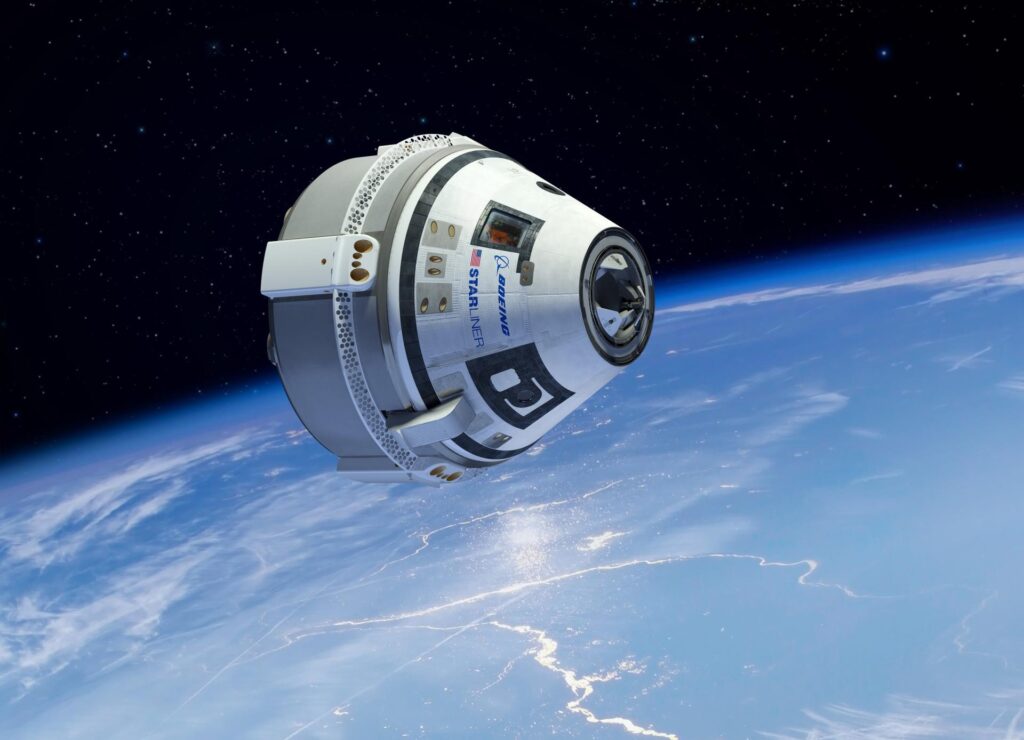
Boeing Starliner’s Comeback: Uncrewed Flight This Winter, Astronauts in 2028
Last updated: October 10, 2026.
Boeing’s Starliner is getting a second chance. On September 28, 2026, NASA laid out an official roadmap to return the troubled Boeing Starliner spacecraft to flight: an uncrewed engineering mission to the International Space Station as early as December 2026, followed by the first crewed Starliner flight since the 2024 fiasco, targeted for mid-2028. The price tag for the comeback is $359 million, and the plan includes a new rocket, a new commander, and a full redesign of the thruster hardware that caused the trouble. Here is the whole story.
What Went Wrong in 2024
Starliner’s Crew Flight Test launched in June 2024 with NASA astronauts Suni Williams and Butch Wilmore aboard for what was supposed to be a roughly 10-day shakedown cruise. It did not go as planned. Helium leaked from the propulsion system on the way up, five service-module thrusters failed during the approach to the station, and a separate crew-module thruster misbehaved on the way home.

The astronauts did make it to the station, but NASA lost confidence in bringing them home on Starliner. The capsule returned to Earth empty in September 2024, and Williams and Wilmore stayed aboard the ISS for about 286 days before riding home on a SpaceX Crew Dragon in March 2025. In February 2026, NASA classified the mission as a Type A mishap, the most serious category the agency assigns.
What the Boeing Starliner Investigation Found
The mishap investigation produced 61 recommendations and finally pinned down the root causes. The service-module thruster failures traced to the valves: seal material in the helium pressurization system broke down after long exposure to the oxidizer, degrading performance. Boeing has since switched to a different seal material and sized the seals at the larger end of the tolerance range.
The crew-module thruster problem was corrosion. Leftover hydrazine propellant reacted with carbon dioxide in the air to form an acid that ate into stainless steel. The fix is procedural: flush the thrusters between missions and keep them purged so no fuel sits around to react. Investigators also found the service-module thrusters had been operating outside their qualified engineering environment, a combination of thermal conditions and propulsion system design features that ground testing later reproduced.
The Comeback Plan: Two Flights
NASA’s roadmap, announced by Administrator Jared Isaacman alongside Boeing and program officials at Kennedy Space Center, rests on two sequential missions. Notably, both will rely on the Boeing Starliner to demonstrate the redesign’s success and future flight potential.
Starliner-1: the uncrewed dress rehearsal. Targeted for no earlier than December 2026 or January 2027, Starliner-1 will fly to the ISS with cargo instead of crew. NASA is blunt that this flight is an engineering evaluation, not a certification mission. It will validate the improved thermal environment around the propulsion system and collect the on-orbit performance data that ground chambers cannot reproduce: eclipse cycling, sustained vacuum, and the exact solar-heating geometry of a live docking approach.
Starliner-2: the crew returns. After Starliner-1 comes the deeper surgery. Boeing will complete the full redesign of the service-module thruster valve hardware, replace the valves on all 12 crew-module thrusters across both of its spacecraft, install new batteries, redesign parachute joints, and add a higher-frequency data recorder. Only then does the first crewed Starliner flight since 2024 lift off, targeted for mid-2028, commanded by NASA astronaut Warren “Woody” Hoburg, a veteran of a 186-day spaceflight. His crewmates have not been named yet. Importantly, the Boeing Starliner will continue to be evaluated during these preparatory flights.
The $359 Million Question
The $359 million package covers the thruster redesign work plus something entirely separate: human-rating a new rocket. Starliner has always launched on United Launch Alliance’s Atlas V, but the Atlas V is retiring, and NASA’s remaining inventory is spoken for. Future Starliners will fly on ULA’s Vulcan Centaur, which has never carried people. Certifying Vulcan for human spaceflight is a first-of-its-kind process and a meaningful chunk of the money.
For perspective on the spending: NASA has paid Boeing more than $5.1 billion under the Commercial Crew program so far, and Boeing itself has absorbed over $2 billion in cost overruns on Starliner. The $359 million is NASA’s bet that the vehicle is close enough to the finish line to be worth saving.
Why NASA Is Sticking With Boeing Starliner
It comes down to redundancy. NASA has wanted two independent American crew vehicles since the Commercial Crew program began, so that a problem with one does not strand the agency’s access to orbit. Right now SpaceX’s Crew Dragon is the only operational American astronaut ferry, and SpaceX has signaled that Dragon and Falcon will eventually retire as Starship matures, with retirement eyed around 2030. Meanwhile, Boeing Starliner remains essential for maintaining access to space.
NASA has also exercised options for a fifth and sixth Starliner flight, bringing the planned manifest to six missions. With the space station’s retirement looming around 2030, Starliner does not have forever to prove itself, but if the December flight goes well and the redesign holds, America’s second space taxi finally gets back on the road.
Frequently Asked Questions
When will Starliner fly again?
Starliner-1, an uncrewed engineering flight to the International Space Station, is targeted for no earlier than December 2026 or January 2027. It will carry cargo and test propulsion fixes, but it will not certify the spacecraft to carry crew. In summary, Boeing Starliner is on track with NASA’s updated plan.
What went wrong with Starliner in 2024?
During the June 2024 Crew Flight Test, helium leaks and five failed service-module thrusters plagued the approach to the ISS, with a separate crew-module thruster issue on descent. NASA brought the capsule home empty and classified the mission a Type A mishap. Astronauts Suni Williams and Butch Wilmore stayed on the station about 286 days and returned on a SpaceX Dragon in March 2025.
When will astronauts fly on Starliner again?
Starliner-2, the first crewed Starliner mission since 2024, is targeted for mid-2028. NASA astronaut Warren “Woody” Hoburg has been named as commander. Before that flight, Boeing must complete the thruster valve redesign, install new crew-module thrusters and batteries, and finish certification work.
Why is Starliner switching rockets?
Starliner has flown on United Launch Alliance’s Atlas V, which is being retired. Future missions will use ULA’s Vulcan Centaur, which has never carried astronauts. Part of NASA’s $359 million package funds the first-of-its-kind process of human-rating Vulcan for crew flights.
Why is NASA still funding Starliner instead of canceling it?
NASA wants two independent American crew vehicles so a problem with one does not cut off access to orbit. SpaceX’s Crew Dragon is currently the only operational US astronaut ferry, and SpaceX plans to eventually retire Dragon around 2030. NASA judges Starliner close enough to readiness to be worth the $359 million fix.