
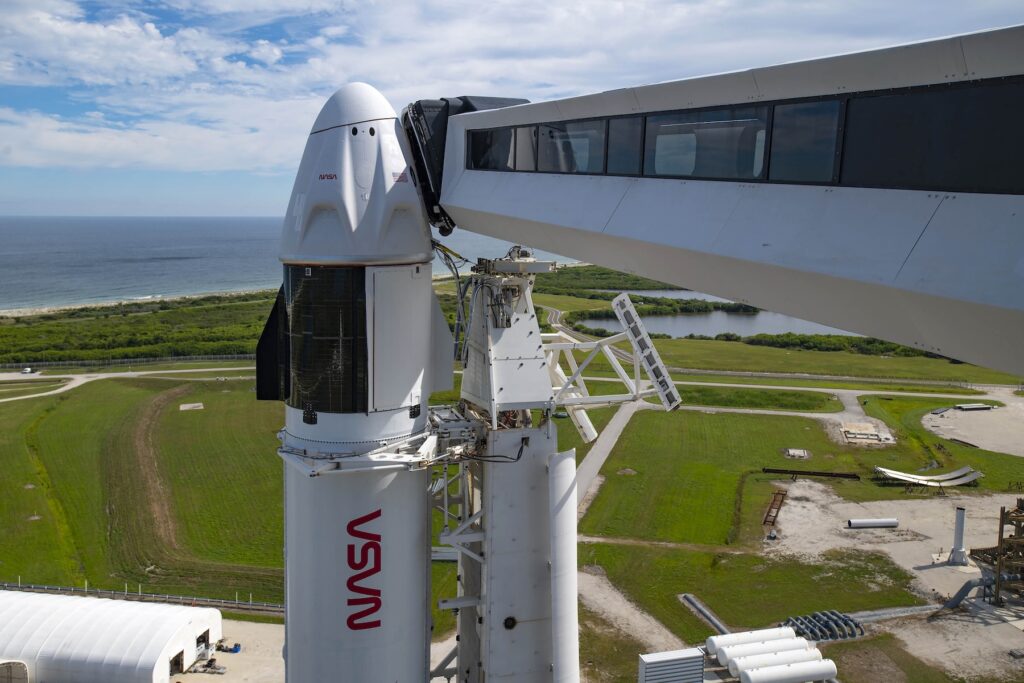
SpaceX Is Retiring Crew Dragon and Falcon: What Replaces Them?
Last updated: October 9, 2026.
It was the quiet bombshell of the fall space season. At a September 28 press conference, NASA Administrator Jared Isaacman said of SpaceX‘s workhorse vehicles: “I do not think it’s a secret that SpaceX intends to sunset older platforms like Falcon and Dragon as they concentrate on their next-generation capability, Starship.” The Falcon 9 is the most-flown rocket in history. Crew Dragon is currently America’s only ride to the space station. So what does “sunset” actually mean, and what replaces them?
What “Sunset” Actually Means
First, do not panic. This is a gradual phase-out, not a shutdown. SpaceX has agreed to support the International Space Station through its planned retirement around 2030. Additionally, NASA has contracted at least four more Crew Dragon rotation missions through the end of the decade. Crew-13 launched on October 1, 2026, carrying NASA astronauts Jessica Watkins and Luke Delaney, Canadian astronaut Joshua Kutryk, and Russian cosmonaut Sergey Teteryatnikov. Furthermore, more Dragon flights are already on the books.
The shift is about where SpaceX puts its energy next. Starship is the company’s future. Every dollar and engineer spent keeping Falcon and Dragon flying indefinitely is one not spent making Starship routine.
Why SpaceX Is Moving On
SpaceX president Gwynne Shotwell put it bluntly at a recent conference: “If we don’t obsolete our own products and services, someone’s going to find a way to obsolete them for us.” There is also money involved. In its first quarterly earnings report, SpaceX revealed that its space segment, which includes Falcon, Dragon, and Starship, lost $542 million. Meanwhile, its Starlink internet business made nearly $1.7 billion. So, Starlink is the business now, and Starship is the bet.
Falcon 9 is going out on top. The rocket flew 77 times in the first half of 2026 alone. Most of the remaining commercial manifest is already sold. Reports suggest that beyond early 2029, the remaining Falcon flights may be reserved for US government missions. Moreover, commercial satellite operators are already scrambling to lock in their last Falcon rides.

What Happens to Crew Missions
This is where it gets real for NASA. SpaceX has reportedly told companies building commercial space stations, including Axiom Space, Voyager Space, and Vast, that they will not be able to order Crew Dragon missions for their future habitats. Once the ISS retires around 2030, Dragon is expected to retire with it.
That leaves a gap, and NASA is already filling it. The agency is paying Boeing $359 million to bring Starliner back from the brink. An uncrewed Starliner-1 test flight is targeted for December 2026 or January 2027. Meanwhile, a crewed Starliner-2 flight in mid-2028 will be commanded by Woody Hoburg. As NASA’s low Earth orbit program manager Dana Weigel put it, once Falcon 9 and Crew Dragon are gone, Starliner is what the agency intends to fly into the future. You can follow that story in our Commercial Crew Program guide.
What Replaces Falcon and Dragon
The replacement plan has three parts. For NASA astronauts heading to the space station, Boeing’s Starliner is the near-term answer, with its comeback flights now officially on the calendar. For cargo, Sierra Space’s Dream Chaser spaceplane is targeting its first flight late this year on a ULA Vulcan rocket. This will add a winged resupply option for the first time since the shuttle era.
And for everything else, there is Starship. If Flight 14’s orbital milestone and the catch attempts planned for Flight 15 deliver, SpaceX’s giant rocket becomes the company’s do-everything vehicle: crew, cargo, Starlink, and the Artemis lunar landings. The transition will take years and will not be smooth, but the direction is now set. Track every upcoming flight on the upcoming launch schedule.
The end of an era is also the start of one. Falcon 9 and Dragon proved that commercial companies could fly people to orbit safely and routinely. Now, whatever replaces them has a high bar to clear. Follow the story with Space Launch Schedule on Facebook, on the website, or with launch alerts from the iOS or Android app, and never miss the moment the torch passes.
Frequently Asked Questions
Is SpaceX really retiring Crew Dragon and Falcon 9?
Yes, but gradually. NASA Administrator Jared Isaacman confirmed on September 28, 2026, that SpaceX intends to sunset Falcon and Dragon as it concentrates on Starship. The phase-out is tied to the International Space Station’s retirement around 2030, not an immediate shutdown.
When will Crew Dragon fly its last mission?
NASA has contracted at least four more Crew Dragon rotation missions through 2030, and SpaceX has agreed to support the ISS until its retirement. Dragon is expected to retire along with the station around 2030. Learn more in our Commercial Crew Program guide.
What will replace Crew Dragon for NASA astronauts?
Boeing’s Starliner is the near-term replacement. NASA is paying Boeing $359 million for its comeback: an uncrewed Starliner-1 test flight in December 2026 or January 2027, then a crewed Starliner-2 flight in mid-2028 commanded by Woody Hoburg. Long term, SpaceX intends for Starship to take over.
Why retire Falcon 9 when it is so successful?
SpaceX president Gwynne Shotwell says the company must obsolete its own products before someone else does. Financially, SpaceX’s space segment lost $542 million in its first quarterly earnings report, while Starlink made nearly $1.7 billion, so the company’s future depends on Starlink revenue funding Starship development.
Can commercial space stations still book Crew Dragon flights?
Reportedly not. SpaceX has told companies developing commercial stations, including Axiom Space, Voyager Space, and Vast, that they will not be able to order Crew Dragon missions for their future habitats, which makes replacement crew vehicles urgent for the post-ISS era.