NASA Commercial Crew Program: How It Works & Mission History
From the Space Shuttle to Commercial Spaceflight
For three decades, NASA’s Space Shuttle was the only way American astronauts reached orbit. When the Shuttle fleet retired in 2011 after the final flight of Atlantis, NASA lost its ability to launch its own crews. For nearly a decade afterward, every NASA astronaut headed to the International Space Station (ISS) had to fly on a Russian Soyuz spacecraft from Kazakhstan, at a cost of tens of millions of dollars per seat.
Rather than build a government-owned Shuttle successor from scratch, NASA took a different approach. Through the Commercial Crew Program, formally established in 2010 and matured through a series of development contracts, the agency set safety and performance requirements and then asked private industry to design, build, own, and operate the spacecraft. NASA would be a customer buying transportation services, not the vehicle’s owner and operator.
In September 2014, NASA awarded Commercial Crew contracts to two companies:
- SpaceX, to develop Crew Dragon, a capsule launched on the company’s own Falcon 9 Block 5 rocket.
- Boeing, to develop the CST-100 Starliner, launched on a United Launch Alliance Atlas V rocket.
SpaceX reached that milestone first. After an uncrewed test flight and a successful in-flight abort test, the company flew NASA astronauts Bob Behnken and Doug Hurley to the ISS on the Demo-2 mission in May 2020 — the first crewed orbital launch from U.S. soil since the Shuttle’s retirement. Crew Dragon was certified for regular operational flights later that year with Crew-1, and SpaceX has flown the majority of NASA’s crew rotations ever since. Boeing’s Starliner has followed a longer development path, with its first crewed test flight occurring in 2024.
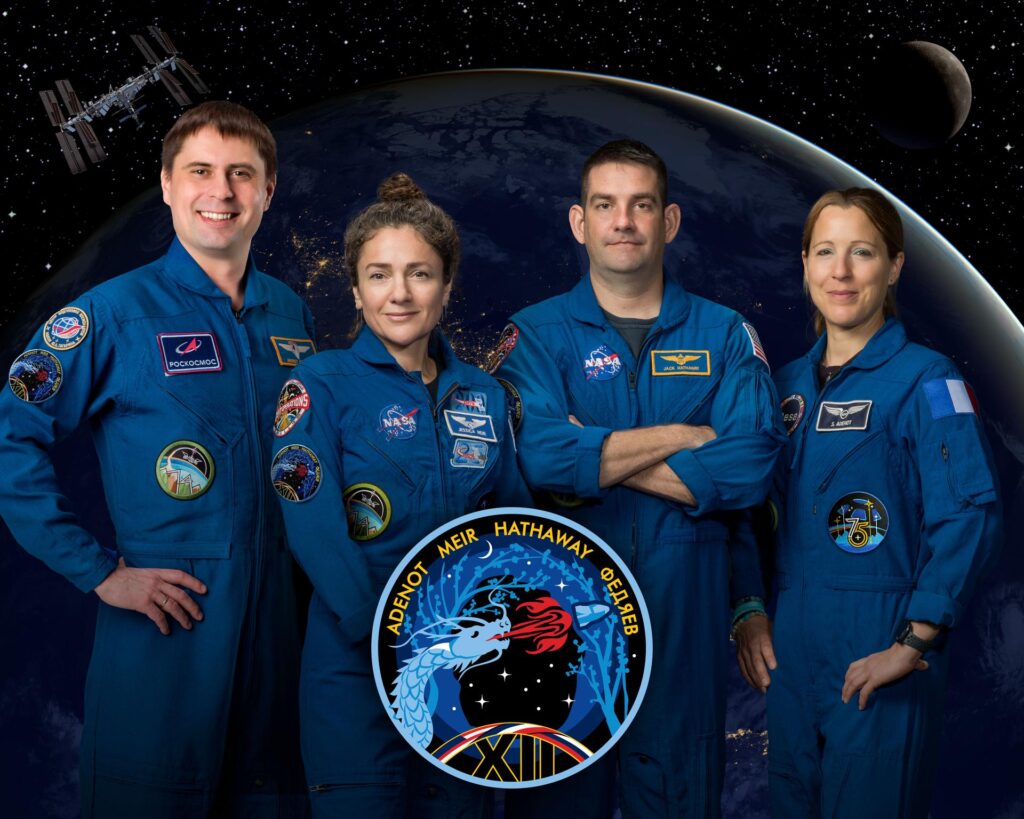
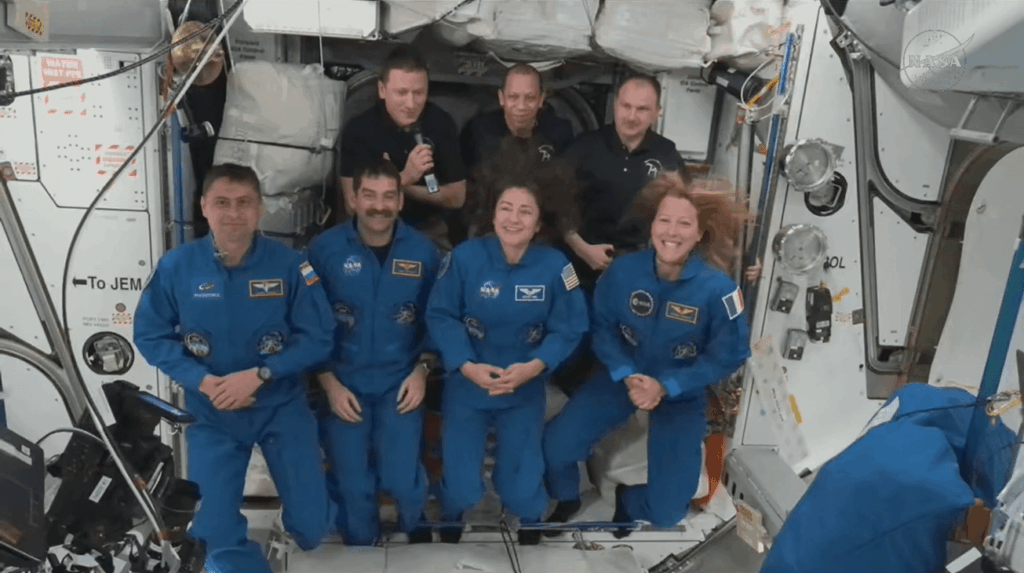
Today, the Commercial Crew Program is NASA’s primary method for rotating astronauts to and from the space station, working alongside international partners including Roscosmos, ESA, JAXA, and the Canadian Space Agency (CSA), who regularly fly seats on Crew Dragon missions as part of cross-agency crew-swap agreements. You can browse every past and upcoming rotation on our Crew Dragon mission archive.
Anatomy of a Crewed Mission: Launch to Splashdown
Every operational Crew Dragon mission follows a broadly similar sequence of events, whether it’s a short-duration flight or a standard six-month ISS rotation. Here’s what happens, phase by phase. Check the launch page for your specific mission for exact timing.
1. Launch
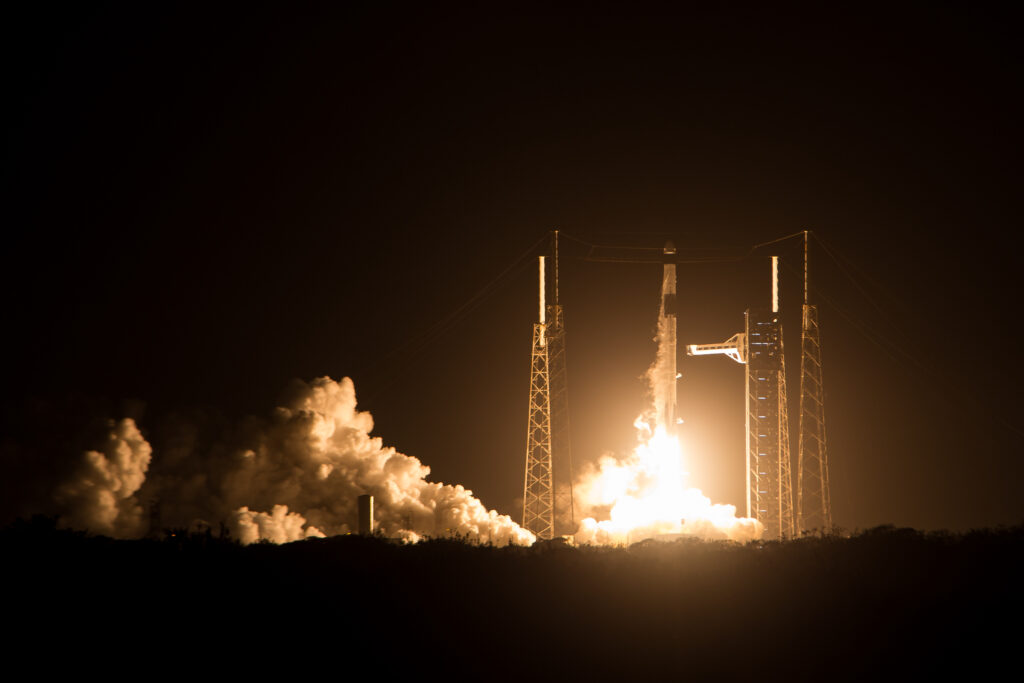
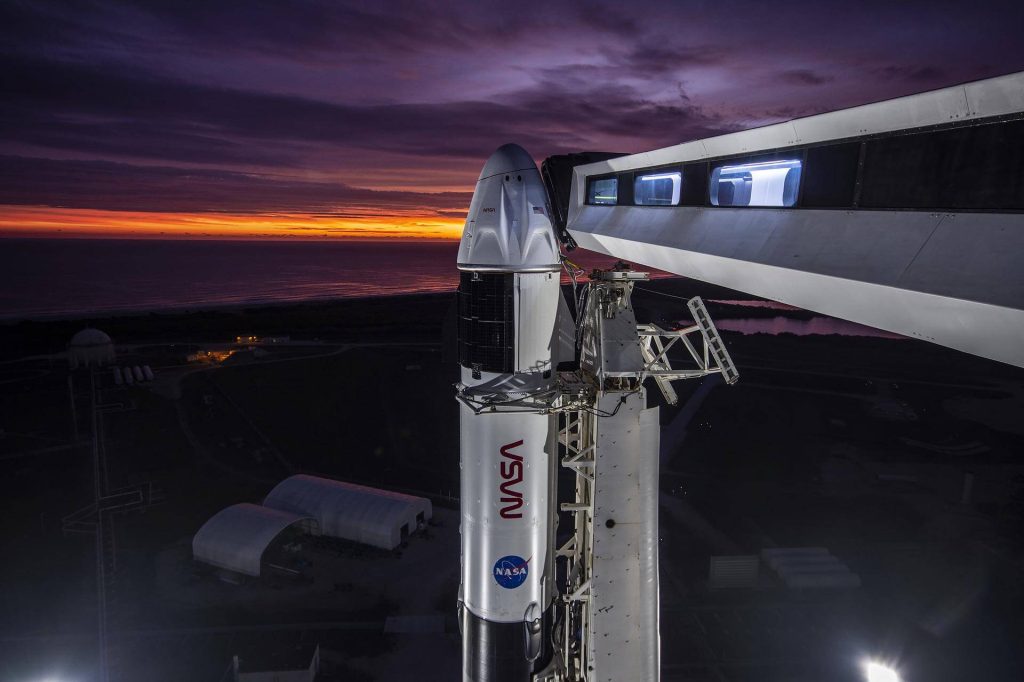
Crewed missions typically launch from Launch Complex 39A at Kennedy Space Center or Space Launch Complex 40 at Cape Canaveral Space Force Station, both in Florida, the same coastline NASA has used for human spaceflight since the Mercury and Apollo programs. Roughly two hours before liftoff, the crew suits up, rides to the pad, and boards the Dragon capsule sitting atop a Falcon 9 Block 5 rocket.
At T-0, the Falcon 9’s nine Merlin engines ignite and the vehicle lifts off. About a minute in, it passes through Max Q, the point of peak aerodynamic stress. Around two and a half minutes after launch, the first and second stages separate; the reusable first-stage booster performs a series of engine burns to land itself, either back near the launch site or on a droneship in the Atlantic, while the second stage continues carrying Dragon toward orbit. Roughly twelve minutes after liftoff, Dragon separates from the second stage and opens its nose cone, exposing the docking mechanism and forward sensors for the trip to the station.
2. Orbital Rendezvous
Once in orbit, Dragon spends anywhere from a few hours to about a day chasing down the ISS, which orbits Earth roughly every 90 minutes at about 250 miles (400 km) altitude. The spacecraft performs a series of automated thruster burns to gradually match the station’s orbit, closing the distance in stages while flight controllers on the ground — and the station’s own crew — monitor its approach.
3. ISS Docking
Dragon flies itself to the station autonomously, using cameras, sensors, and the ISS’s docking navigation system, though the crew can take manual control if needed. The capsule docks — rather than berths — meaning it connects directly to a docking adapter on the station’s Harmony module without needing to be grappled by the station’s robotic arm. After docking, ground teams run leak checks on the vestibule between the two spacecraft before the hatch opens and the arriving crew is welcomed aboard by the station’s existing Expedition crew.
For standard rotation missions, the newly arrived crew overlaps with the crew they’re replacing for several days to a week, handing over experiments, station systems knowledge, and Dragon seat liners before the outgoing crew departs and heads for splashdown.
4. Life and Work Aboard the ISS
Once docked, Dragon remains attached to the station for the duration of the mission — typically around six months for standard rotations — serving as the crew’s return vehicle and an emergency lifeboat if the station ever needed to be evacuated. During this period, astronauts conduct scientific research, spacewalks, station maintenance, and technology demonstrations as part of an ISS Expedition crew. You can find each crew member’s full flight history on their astronaut bio page.
5. Undocking and Splashdown
At the end of the mission, the crew boards Dragon, undocks from the station, and performs a deorbit burn that drops the capsule out of orbit. After a fiery re-entry through the atmosphere, Dragon deploys a sequence of parachutes and splashes down in the ocean off the coast of Florida or California, where a SpaceX recovery ship retrieves the capsule and crew — typically clearing the way for the next mission’s launch window to open.
SpaceX vs. Boeing: Two Paths to the Same Program
While SpaceX’s Crew Dragon has flown the vast majority of Commercial Crew rotations, Boeing’s Starliner is the program’s second certified vehicle, giving NASA redundant, independent access to the ISS rather than relying on a single company or spacecraft. Having two providers means a technical grounding of one vehicle doesn’t strand NASA’s ability to launch and return astronauts — a lesson drawn directly from the single-vehicle risk NASA carried during the Shuttle era.
Explore More
- Browse individual Crew Dragon and Starliner mission pages, including this launch’s own mission page, for launch windows, crew assignments, and splashdown coverage.
- Read astronaut bios for every NASA, ESA, JAXA, CSA, and Roscosmos crew member who has flown under the Commercial Crew Program.
- Check the launch schedule for the next Commercial Crew rotation and other upcoming Falcon 9 flights.
- Visit the NASA agency hub for an overview of the ISS, Artemis, and NASA’s other active programs.