
SpaceX SDA Tranche 1 Transport Layer E Falcon 9 Block 5
Rocket Launch Video Streams
Weather Forecast During Launch
According to weather officials, there's a 100% chance of favorable weather conditions at the time of the launch. The forecast calls for a temperature of 77°F, clear skies, 5% cloud cover and a wind speed of 15mph.
Rocket Launch Trajectory & Flight Path
Track the complete rocket launch trajectory with real-time flight data from FlightClub.io (opens in a new tab). View detailed telemetry including rocket velocity, altitude progression, thrust levels, acceleration, orbital insertion parameters, and 3D flight path visualization throughout all mission phases from liftoff to orbit.
Learn about rocket launch trajectory physics (opens in a new tab)
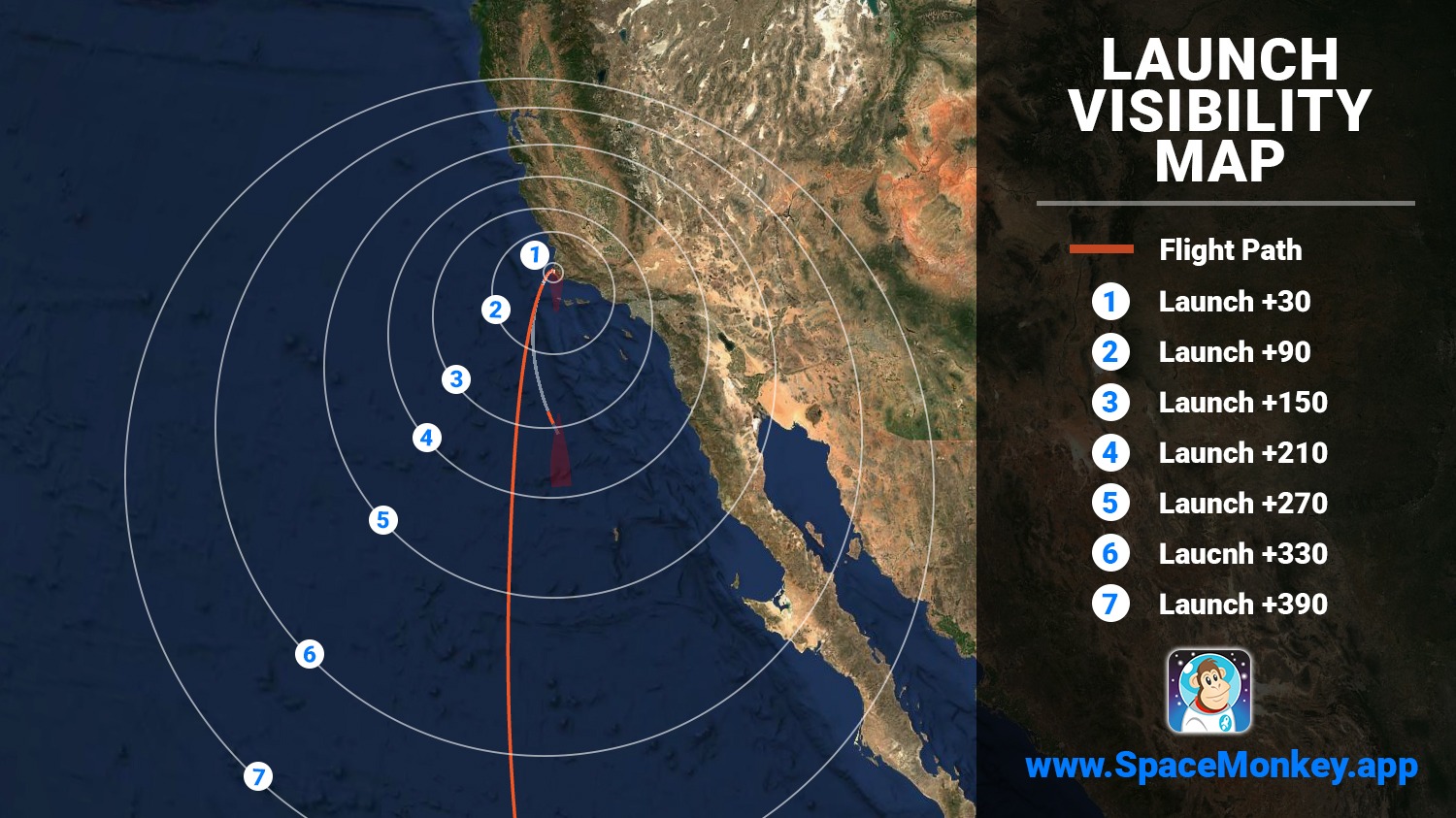
Rocket Launch Timeline
Track every phase of the rocket launch with our detailed mission timeline. From T-minus countdown events and pre-launch preparations through liftoff, stage separation, and orbital insertion, follow each critical milestone in real-time. Our comprehensive launch sequence timeline includes payload integration, propellant loading, engine ignition, and post-launch telemetry tracking.
| Time | Event |
|---|---|
| T- 00 : 38 : 00 | GO for Prop Load Launch director verifies go for propellant load |
| T- 00 : 35 : 00 | Prop Load Start of propelland loading |
| T- 00 : 35 : 00 | Stage 1 LOX Load Start of liquid oxygen loading in the first stage |
| T- 00 : 16 : 00 | Stage 2 LOX Load Start of liquid oxygen loading in the second stage |
| T- 00 : 07 : 00 | Engine Chill Start of engine chilling |
| T- 00 : 01 : 00 | Tank Press Fuel tanks are pressurized to flight levels |
| T- 00 : 01 : 00 | Startup The onboard computer takes control over the countdown and runs last checks |
| T- 00 : 00 : 45 | GO for Launch Launch director verifies go for launch |
| T- 00 : 00 : 03 | Ignition Start of the engine ignition sequence |
| T+ 00 : 00 : 00 | Liftoff First upwards movement of the rocket |
| T+ 00 : 01 : 14 | Max-Q Maximum dynamic pressure |
| T+ 00 : 02 : 29 | MECO Cut-off of the main engine |
| T+ 00 : 02 : 33 | Stage 2 Separation Separation of the second stage from the first |
| T+ 00 : 02 : 41 | SES-1 First start of the second engine |
| T+ 00 : 03 : 21 | Fairing Separation Separation of the payload fairing |
| T+ 00 : 06 : 23 | Entry Burn Startup Start of the atmospheric entry burn |
| T+ 00 : 06 : 46 | Entry Burn Shutdown End of the atmospheric entry burn |
| T+ 00 : 08 : 13 | Stage 1 Landing Burn Start of the first stage landing burn |
| T+ 00 : 08 : 35 | SECO-1 First cut-off of the second engine |
| T+ 00 : 08 : 37 | Stage 1 Landing Landing of the first stage |
About the SDA Tranche 1 Transport Layer E Mission
| Type | Government/Top Secret |
|---|---|
| Orbit | Polar Orbit |
| Launch Cost | $52,000,000 |
Tranche 1 Transport Layer E is one of six missions by the United States Space Force Space Development Agency (SDA) for the Proliferated Warfighter Space Architecture (PWSA) Tranche 1 Transport Layer constellation, which will provide assured, resilient, low-latency military data and connectivity worldwide to the full range of warfighter platforms from Low Earth Orbit satellites.
The constellation will be interconnected with Optical Inter-Satellite Links (OISLs) which have significantly increased performance over existing radio frequency crosslinks. It is expected to operate over Ka band, have stereo coverage and be dynamically networked for simpler hand-offs, greater bandwidth and fault tolerance.
This launch carries 21 satellites manufactured by York Space Systems.
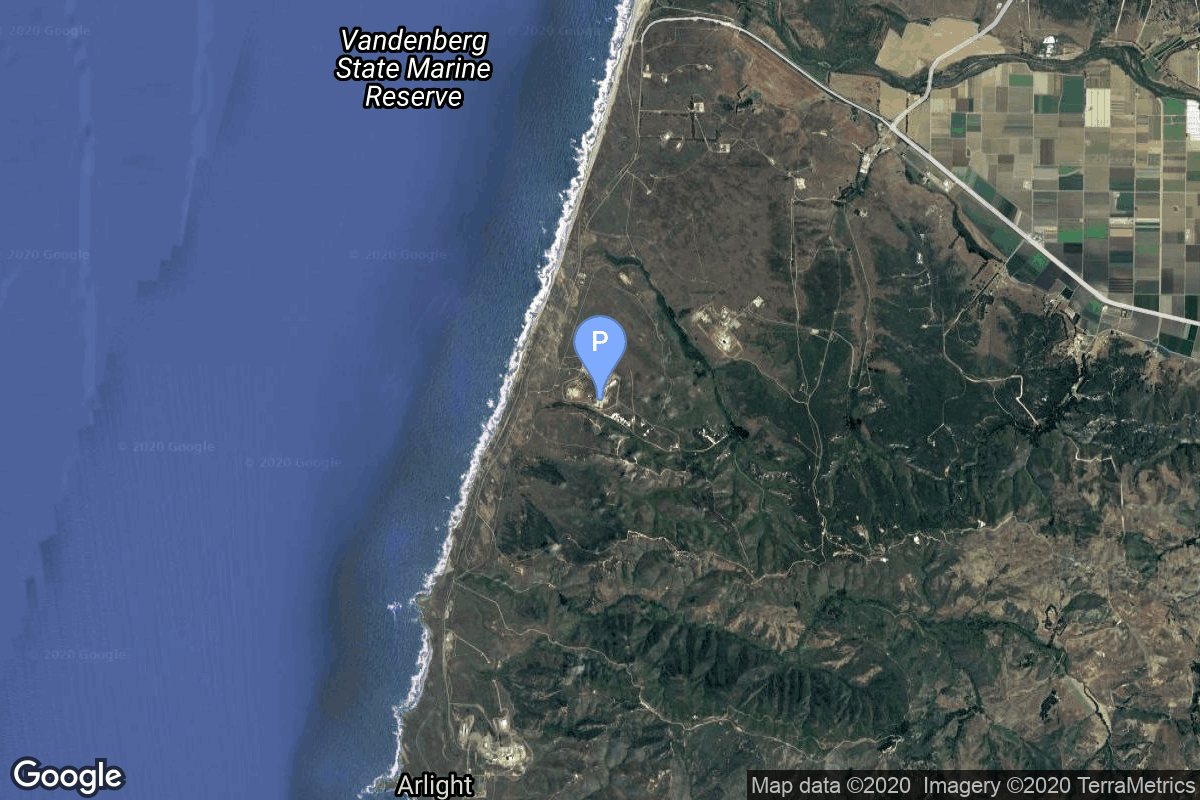
Launch Pad & Location
Space Launch Complex 4E
Vandenberg SFB, CA, USA
| Launches | 298 |
|---|---|
| Orbital Launch Attempts | 298 |
| Total Launches | 914 |
Vandenberg Space Force Base is a United States Space Force Base in Santa Barbara County, California. Established in 1941, Vandenberg Space Force Base is a space launch base, launching spacecraft from the Western Range, and also performs missile testing. The United States Space Force's Space Launch Delta 30 serves as the host delta for the base, equivalent to an Air Force air base wing. In addition to its military space launch mission, Vandenberg Space Force Base also hosts space launches for civil and commercial space entities, such as NASA and SpaceX.
SpaceX Falcon 9 Block 5 Rocket
Falcon 9 is a two-stage rocket designed and manufactured by SpaceX for the reliable and safe transport of satellites and the Dragon spacecraft into orbit. The Block 5 variant is the fifth major interval aimed at improving upon the ability for rapid reusability.
| Length | 70.0 m |
|---|---|
| Diameter | 3.7 m |
| Stages | 2 |
| Launch Mass | 549.0 T |
| Takeoff Thrust | 7,607.0 kN |
| Apogee | 200.0 km |
| LEO Capacity | 22,800 kg |
| GTO Capacity | 8,300 kg |
| Launch Cost | $52,000,000 |
| Maiden Flight | 5/11/2018 |

Booster Landing & Recovery
Core B1103
| Serial Number | B1103 |
|---|---|
| Last Flight | 08/12/2026 |
| Successful Landings | 5 |
Falcon 9 booster. The Falcon 9 first stage B1103 has landed on ASDS OCISLY after its 4th flight.
Of Course I Still Love You - OCISLY
The second ASDS barge, Of Course I Still Love You (OCISLY) services launches in the Pacific Ocean and was the site of the first landing of a SpaceX Falcon 9 first stage during CRS-8, the launch of a Dragon spacecraft to the International Space Station.
Autonomous Spaceport Drone Ship - ASDS
An autonomous spaceport drone ship (ASDS) is an ocean-going vessel derived from a deck barge, outfitted with station-keeping engines and a large landing platform. Construction of such ships was commissioned by aerospace company SpaceX to allow for recovery of rocket first-stages at sea for high-velocity missions which do not carry enough fuel to return to the launch site after lofting spacecraft onto an orbital trajectory.
Track the booster recovery and droneship return to port (opens in a new tab)
About SpaceX
Space Exploration Technologies Corp., known as SpaceX, is an American aerospace manufacturer and space transport services company headquartered in Hawthorne, California. It was founded in 2002 by entrepreneur Elon Musk with the goal of reducing space transportation costs and enabling the colonization of Mars. SpaceX operates from many pads, on the East Coast of the US they operate from SLC-40 at Cape Canaveral Space Force Station and historic LC-39A at Kennedy Space Center. They also operate from SLC-4E at Vandenberg Space Force Base, California, usually for polar launches. Another launch site is being developed at Boca Chica, Texas.
| Total Launches | 730 |
|---|---|
| Successful | 715 |
| Failed | 15 |
| Pending | 128 |
| Consecutive Success | 215 |

Frequently Asked Questions
When was the SpaceX Falcon 9 SDA Tranche 1 Transport Layer E launch scheduled?
The SpaceX Falcon 9 SDA Tranche 1 Transport Layer E launch was scheduled for:
.
Where can I watch the SpaceX Falcon 9 SDA Tranche 1 Transport Layer E launch video?
You can watch the SpaceX Falcon 9 launch video on this page. The official video includes full mission coverage with multiple camera angles, onboard views, and expert commentary covering pre-launch procedures, liftoff, stage separation, and payload deployment.
Where did the SpaceX Falcon 9 SDA Tranche 1 Transport Layer E mission launch from?
The SpaceX Falcon 9 rocket launched from Space Launch Complex 4E at Vandenberg SFB, CA, USA. Vandenberg Space Force Base is a United States Space Force Base in Santa Barbara County, California. Established in 1941, Vandenberg Space Force Base is a space launch base, launching spacecraft from the Western Range, and also performs missile testing. The United States Space Force's Space Launch Delta 30 serves as the host delta for the base, equivalent to an Air Force air base wing. In addition to its military space launch mission, Vandenberg Space Force Base also hosts space launches for civil and commercial space entities, such as NASA and SpaceX.
What rocket was used for the SDA Tranche 1 Transport Layer E mission?
The SDA Tranche 1 Transport Layer E mission launched aboard a SpaceX Falcon 9 rocket. Falcon 9 is a two-stage rocket designed and manufactured by SpaceX for the reliable and safe transport of satellites and the Dragon spacecraft into orbit. The Block 5 variant is the fifth major interval aimed at improving upon the ability for rapid reusability. Detailed rocket specifications and performance data are available in the rocket details above.
Did the SpaceX Falcon 9 booster for SDA Tranche 1 Transport Layer E attempt a landing?
Yes, the Falcon 9 first stage booster attempted a Autonomous Spaceport Drone Ship at a designated landing zone. Booster recovery allows SpaceX to reuse rocket components, significantly reducing launch costs. Learn more about the landing details.
What weather conditions could have delayed the SpaceX Falcon 9 SDA Tranche 1 Transport Layer E launch?
The SpaceX Falcon 9 SDA Tranche 1 Transport Layer E launch could have been delayed by various weather conditions including lightning within 10 nautical miles, high winds (especially upper-level winds), thick cloud layers, precipitation, and poor visibility. Weather must be favorable at the launch site, downrange landing zones, and abort landing sites.
How can I get updates if the SpaceX Falcon 9 SDA Tranche 1 Transport Layer E launch was delayed?
This page was updated in real-time with the latest SpaceX Falcon 9 launch status, including any delays or scrubs for the SDA Tranche 1 Transport Layer E mission. You can also check our space launch schedule for historical launch information. Our mobile app provides push notifications for instant alerts about launch status changes. Official SpaceX live streams provided the most immediate range updates during the launch window.
Last Updated
Last Updated:
-
Launch success.
-
Unofficial Re-stream by SPACE AFFAIRS has started
-
Liftoff.
-
Unofficial Re-stream by SPACE AFFAIRS has started
-
Tweaked T-0.
-
Tweaked T-0.
-
GO for launch.
-
NET July 16 per marine navigation warnings, TBC.
-
Adding launch