
Never Miss a Rocket Launch

Get the Space Launch Schedule your way with our apps, content, and supporter benefits.

Get Our Mobile App

View the launch schedule, receive notifications, and watch live video on iOS or Android.

Go Ad-Free

Support us on Patreon for just $3/month and enjoy an ad-free website experience.

Get Social

Receive the daily launch schedule and follow our latest launch coverage on social media.

Space Images November 23, 2026

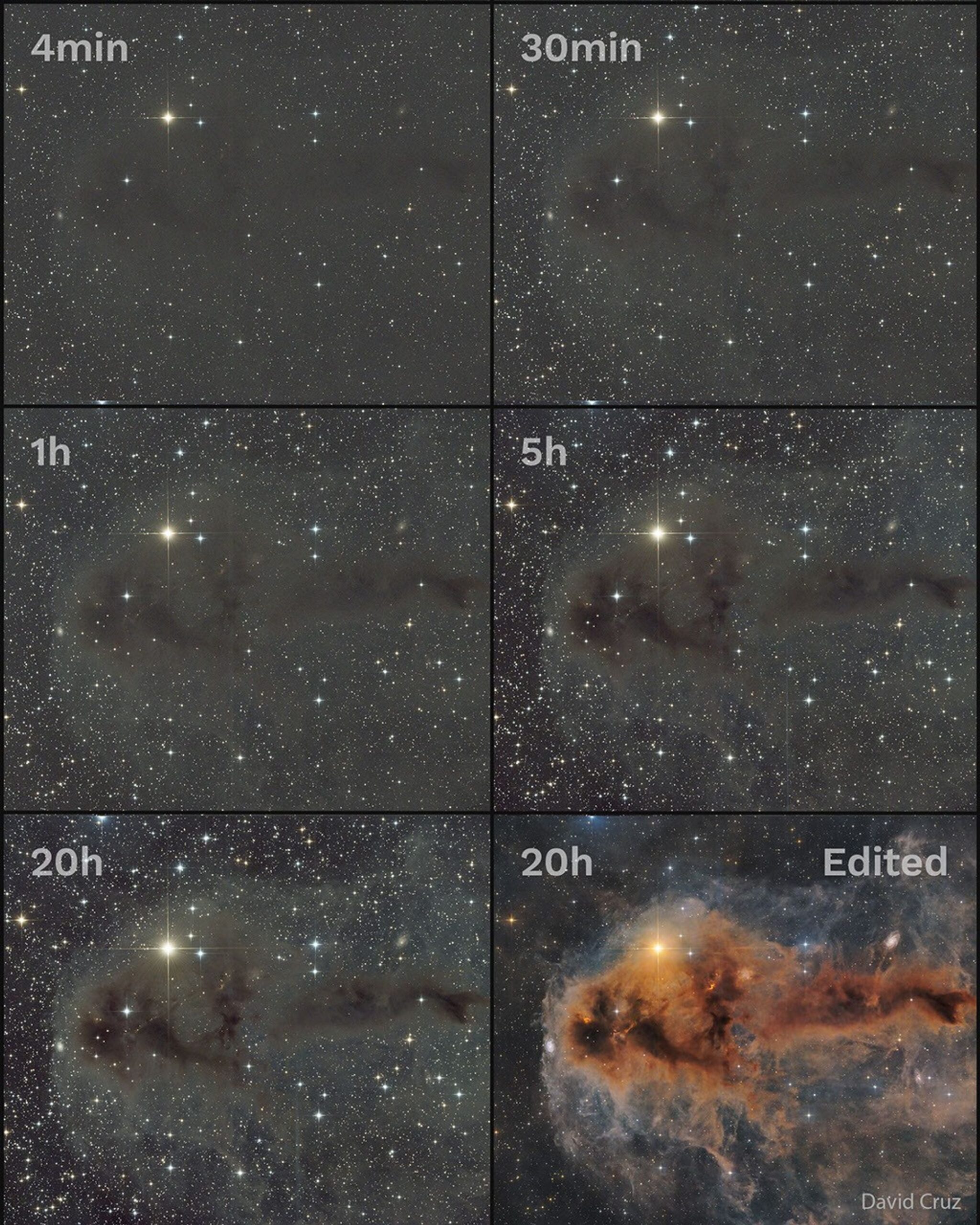
The Emergence of Dark Nebula Lynds 1251
NASA APOD

Six panels of images, all of the same spot in the sky taken at different points in a long exposure of a faint object. The top left panel is the earliest image, taken 4 minutes into the exposure. There is a very faint wisp of dark material slightly blocking the background smattering of stars. With each successive panel, the dark wisp becomes more and more pronounced. The final image in the bottom right contains all the light collected over 20 hours. The shape and details of the dark nebula are captured in striking detail. It looks like a cloud of smoke drifting across the sky.
David Cruz

Explanation: If you stare into space for a long time, what might you see? At first, you might only see the usual brightest stars, but if your eyes (or camera) could continue to collect light, you would see increasingly more. In the direction of the featured image, after only a few minutes, you would begin to notice some regions without stars. As your staring continued, the dark region would become better defined, and after a full 20 hours, you would notice a strange dark structure. To celebrate, you use digital processing to brighten the image and enhance the colors. At the end, you might have an excellent image of Lynds 1251 (LDN 1251), a star-forming region laced with opaque brown-appearing interstellar dust. Also known as the Rotten Fish Nebula, LDN 1251 is home not only to young stars and dust, but also, your long staring indicates, energetic shock waves, fast stellar winds, and powerfully beamed jets.Tomorrow's picture: galaxies ringing

Laser Focus at the Top of the World

NASA Earth Observatory

A rocky peninsula has several small glaciers along its spine. The surrounding water appears turquoise-green, with streaks of tan sediment coming from the shore. Infrastructure associated with the research settlement of Ny-Ålesund, near the center, are light tan.
NASA Earth Observatory

A next-generation geodetic instrument developed by NASA, part of a network that helps measure satellites’ orbits and the planet’s shape, has debuted in Svalbard, Norway.

guest
0 Comments