Login with Patreon to Remove Ads

3I ATLAS: Tails of an Interstellar Comet

Copyright: Victor Sabet & Julien De Winter How typical is our Solar System? Studying 3I/ATLAS, a comet just passing through, is providing clues. Confirmed previous interstellar visitors include an asteroid, a comet, a meteor, and a gas wind dominated by hydrogen and helium. Comet 3I/ATLAS appears relatively normal when compared to Solar System comets, therefore […]

The Surface of Titan from Huygens

If you could stand on Titan — what would you see? The featured color view from Titan gazes across an unfamiliar and distant landscape on Saturn’s largest moon. The scene was recorded by ESA’s Huygens probe in 2005 after a 2.5-hour descent through a thick atmosphere of nitrogen laced with methane. Bathed in an eerie […]

Moon Games

Copyright: Giorgia Hofer This is not a screen from a video game. Nestled below the tree-line, the small mountain church does look like it might be hiding from Moon though. In the well-composed telephoto snapshot, taken on November 23, the church walls are partly reflecting light from terrestrial flood lights. Of course, the Moon is […]

NGC 6888: The Crescent Nebula

Copyright: Greg Bass NGC 6888, also known as the Crescent Nebula, is a about 25 light-years across, a cosmic bubble blown by winds from its central, massive star. This deep telescopic image includes narrowband image data, to isolate light from hydrogen and oxygen atoms. The oxygen atoms produce the blue-green hue that seems to enshroud […]

Portrait of NGC 1055

Copyright: John Hayes Big, beautiful spiral galaxy NGC 1055 is a dominant member of a small galaxy group a mere 60 million light-years away toward the aquatically intimidating constellation Cetus. Seen edge-on, the island universe spans over 100,000 light-years, a little larger than our own Milky Way galaxy. The colorful, spiky stars decorating this cosmic […]

Globular Cluster M15 Deep Field

Copyright: Alvaro Ibanez Perez Stars, like bees, swarm around the center of bright globular cluster M15. The central ball of over 100,000 stars is a relic from the early years of our Galaxy, and continues to orbit the Milky Way’s center. M15, one of about 150 globular clusters remaining, is noted for being easily visible […]

Comet Lemmon and the Milky Way

Copyright: Lin Zixuan (Tsinghua U.) What did Comet Lemmon look like when it was at its best? One example is pictured here, featuring three celestial spectacles all at different distances. The closest spectacle is the snowcapped Meili Mountains, part of the Himalayas in China. The middle marvel is Comet Lemmon near its picturesque best early […]

Apep: Unusual Dust Shells from Webb

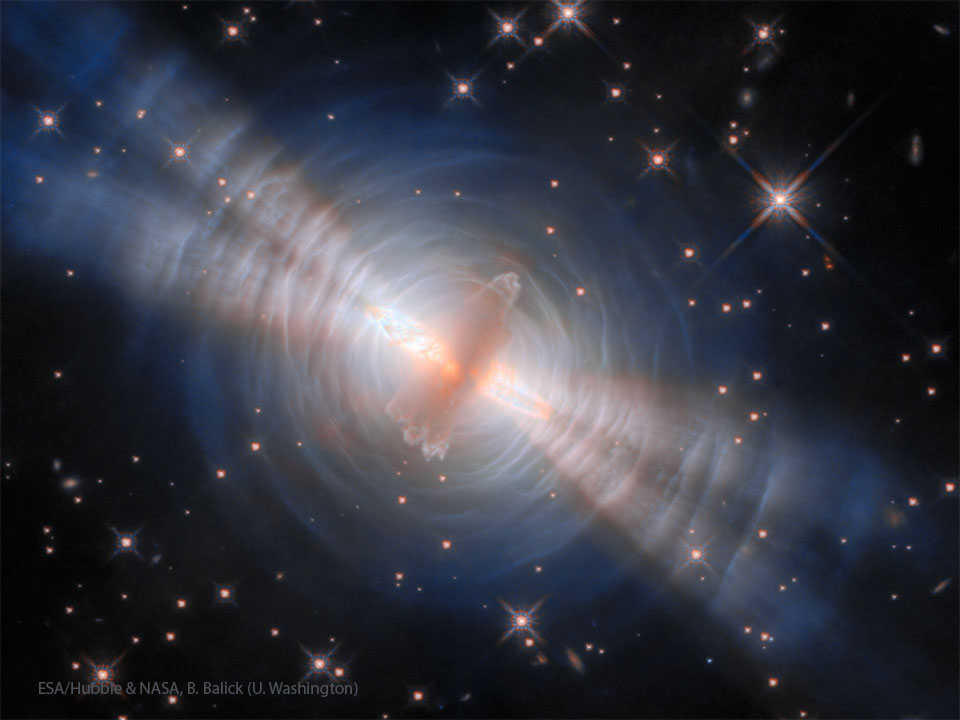
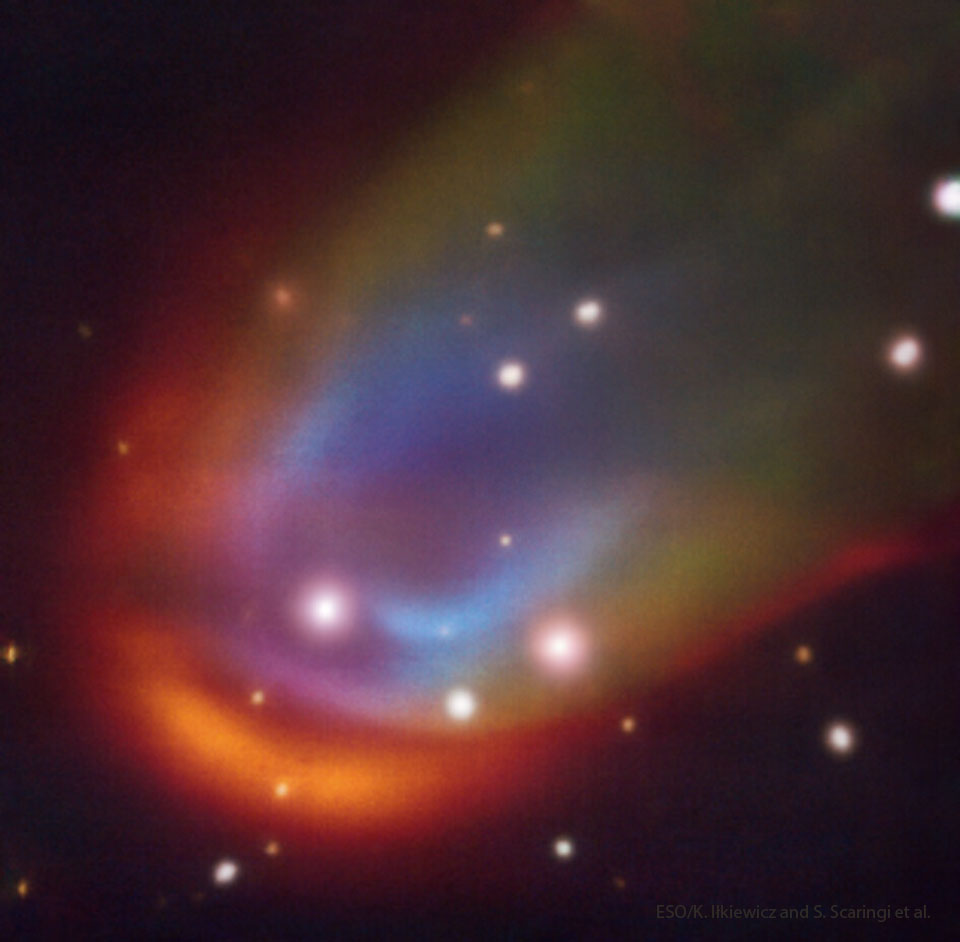
What created this unusual space sculpture? Stars. This unusual system of swirls and shells, known as Apep, was observed in unprecedented detail by NASA’s James Webb Space Telescope in infrared light in 2024. Observations indicate that the unusual shape originates from two massive Wolf-Rayet stars orbiting each other every 190 years with each close passes causing […]

The Observable Universe

How far can you see? Everything you can see, and everything you could possibly see, right now, assuming your eyes could detect all types of radiations around you — is the observable universe. In light, the farthest we can see comes from the cosmic microwave background, a time 13.8 billion years ago when the universe […]

Dione and Rhea Ring Transit

Copyright: Christopher Go Seen to the left of Saturn’s banded planetary disk, small icy moons Dione and Rhea are caught passing in front of the gas giant’s extensive ring system in this sharp telescopic snapshot. The remarkable image was recorded on November 20, when Saturn’s rings were nearly edge-on when viewed from planet Earth. In […]

3I/ATLAS: A View from Planet Earth

Copyright: Rolando Ligustri Now outbound after its perihelion or closest approach to the Sun on October 29, Comet 3I/ATLAS is only the third known interstellar object to pass through our fair Solar System. Its greenish coma and faint tails are seen against a background of stars in the constellation Virgo in this view from planet […]

Alnitak, Alnilam, Mintaka

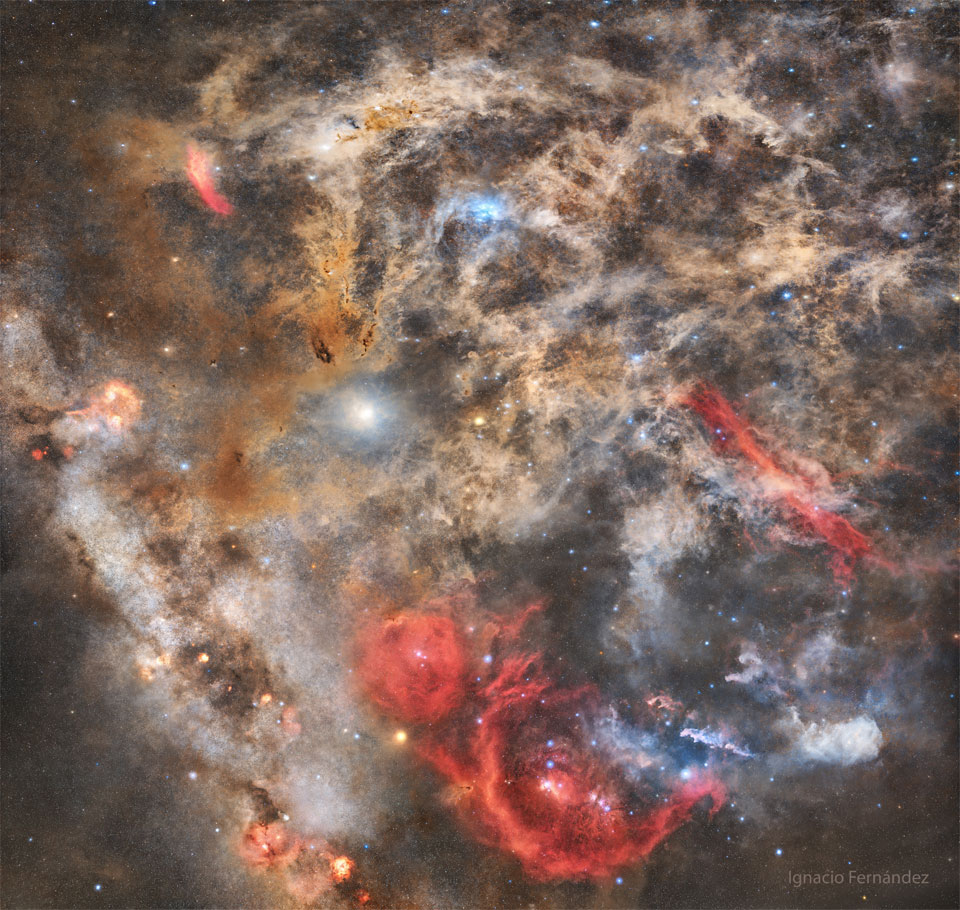
Copyright: Aygen Erkaslan Alnitak, Alnilam, and Mintaka are the bright bluish stars from east to west (upper right to lower left) along the diagonal in this cosmic vista. Otherwise known as the Belt of Orion, these three blue supergiant stars are hotter and much more massive than the Sun. They lie from 700 to 2,000 […]

Chamaeleon Dark Nebulas

Copyright: Xinran Li & Houbo Zhao Sometimes the dark dust of interstellar space has an angular elegance. Such is the case toward the far-south constellation of Chamaeleon. Normally too faint to see, dark dust is best known for blocking visible light from stars and galaxies behind it. In this 11.4-hour exposure, however, the dust is […]

The Galactic Plane: Radio Versus Visible

What does the Milky Way look like in radio waves? To better find out, GLEAM surveyed the central band of our galaxy in high resolution radio light as imaged by the Murchison Widefield Array in Australia. As the featured video slowly scrolls, radio light (71 – 231 MHz) is seen on the left and visible […]

Comet Lemmon’s Wandering Tail

What has happened to Comet Lemmon’s tail? The answer is blowing in the wind — the wind from the Sun in this case. This continuous outflow of charged particles from the Sun has been quite variable of late, as the Sun emits bursts of energy, CMEs, that push out and deflect charged particles emitted by […]