
Koichi Wakata
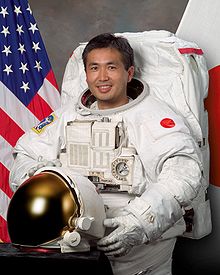
Koichi Wakata is a government astronaut from Japan, affiliated with Japan Aerospace Exploration Agency.
During their career, Koichi Wakata flew on 5 spaceflights and completed 2 spacewalks, logging 504 days, 18 hours, 31 minutes, 45 seconds in space.
Koichi Wakata (若田 光一 Wakata Kōichi, born 1 August 1963) is a Japanese engineer and a JAXA astronaut. Wakata is a veteran of four NASA Space Shuttle missions, a Russian Soyuz mission, and a long-duration stay on the International Space Station. During a nearly two-decade career in spaceflight, he has logged more than eleven months in space. During Expedition 39, he became the first Japanese commander of the International Space Station. Wakata flew on the Soyuz TMA-11M/Expedition 38/Expedition 39 long duration spaceflight from 7 November 2013 to 13 May 2014. During this spaceflight he was accompanied by Kirobo, the first humanoid robot astronaut.
Career Statistics
| Date of Birth | 08/01/1963 |
|---|---|
| Status | Active |
| First Flight | 01/11/1996 |
| Last Flight | 10/05/2022 |
| In Space | No |
| Time in Space | 504 days, 18 hours, 31 minutes, 45 seconds |
| EVA Time | 14 hours, 2 minutes |
| Landings | 5 |
Spaceflights by Koichi Wakata
Explore the 5 spaceflights Koichi Wakata participated in during their astronaut career, including mission details, launch vehicles, and destinations.
Spacewalks by Koichi Wakata
Discover the 2 spacewalks Koichi Wakata performed during their career, logging a total of 14 hours, 2 minutes outside a spacecraft.
The spacewalk began at 01/20/2023 13:14 UTC and ended at 01/20/2023 20:35 UTC on the International Space Station for a total of 7 hours and 21 minutes.
The spacewalk began at 02/02/2023 12:45 UTC and ended at 02/02/2023 19:26 UTC on the International Space Station for a total of 6 hours and 41 minutes.