
Mercury
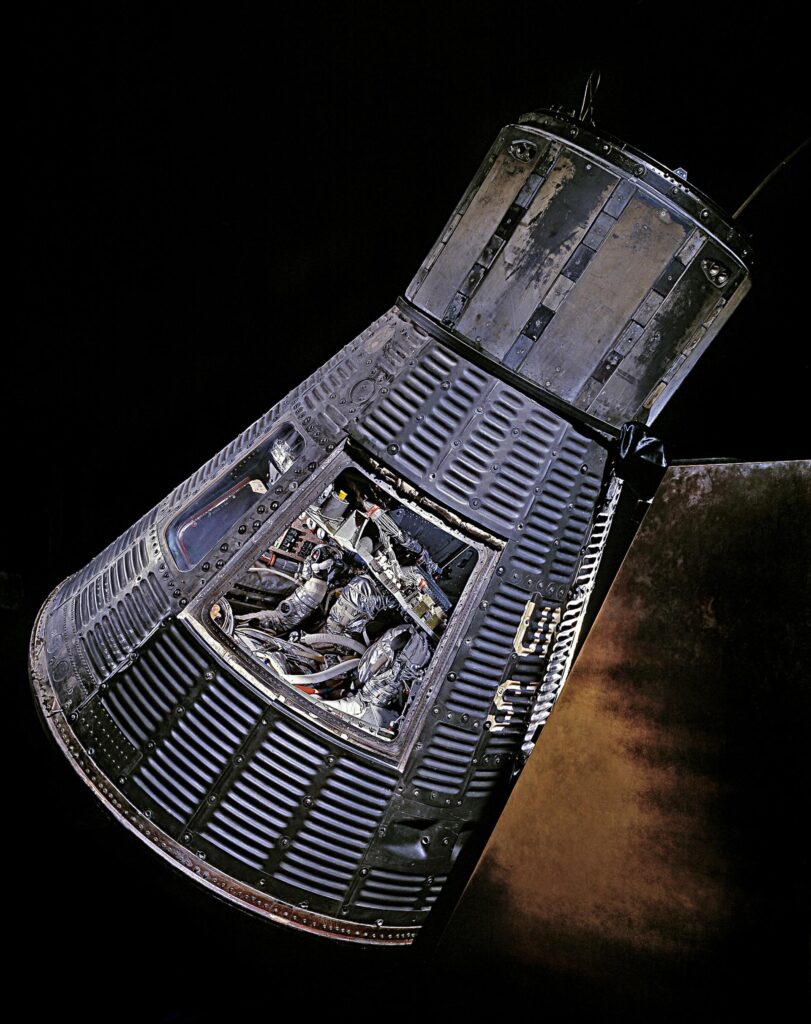
Mercury is a capsule developed by National Aeronautics and Space Administration.
Mission profile: Human transportation to upper Earth atmosphere and low Earth orbit.
The Mercury spacecraft's principal designer was Maxime Faget, who started research for manned spaceflight during the time of the NACA. With 100 cubic feet (2.8 m3) of habitable volume, the capsule was just large enough for a single crew member. Inside were 120 controls: 55 electrical switches, 30 fuses and 35 mechanical levers. The heaviest spacecraft, Mercury-Atlas 9, weighed 3,000 pounds (1,400 kg) fully loaded. Its outer skin was made of René 41, a nickel alloy able to withstand high temperatures.
Spacecraft Specifications & Launch Record
| Height | 3.3 m |
|---|---|
| Diameter | 1.8 m |
| Human Rated | Yes |
| Maiden Flight | 5/5/1961 |
| Crew Capacity | 1 |
| Flight Life | Between 15 minutes and 3 days. |
| Spacecraft Flown | 14 |
| Total Launches | 17 |
| Successful Launches | 12 |
| Failed Launches | 5 |
| Attempted Landings | 15 |
| Successful Landings | 14 |
| Failed Landings | 1 |
| Fastest Turnaround | 28 days 2 hrs 15 min |
History of the Mercury
The Mercury spacecraft was the manned capsule used for suborbital and orbital launches during the Project Mercury, the first human spaceflight program of the United States, from 1958 through 1963.
National Aeronautics and Space Administration Space Agency
The National Aeronautics and Space Administration is an independent agency of the executive branch of the United States federal government responsible for the civilian space program, as well as aeronautics and aerospace research. NASA have many launch facilities but most are inactive. The most commonly used pad will be LC-39B at Kennedy Space Center in Florida.