
Gemini
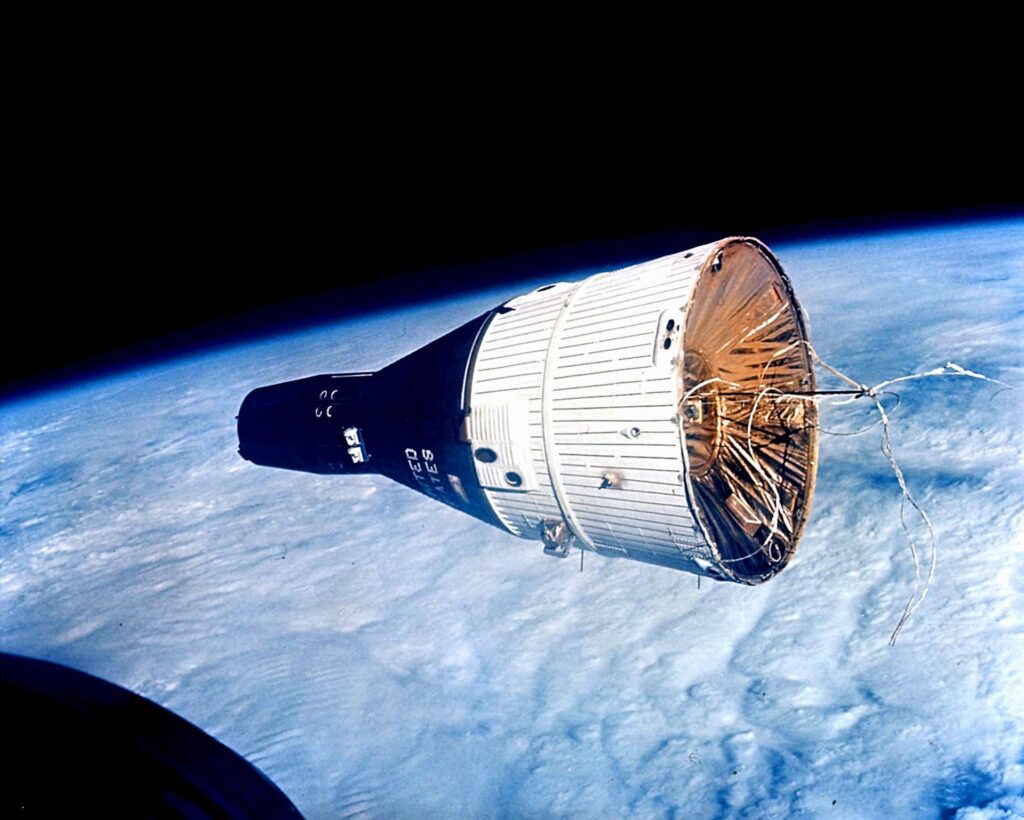
Gemini is a capsule developed by National Aeronautics and Space Administration.
Mission profile: Human transportation to low Earth orbit.
The spacecraft was 18 feet 5 inches (5.61 m) long and 10 feet (3.0 m) wide, with a launch weight varying from 7,100 to 8,350 pounds (3,220 to 3,790 kg).
Spacecraft Specifications & Launch Record
| Height | 5.61 m |
|---|---|
| Diameter | 3 m |
| Human Rated | Yes |
| Maiden Flight | 4/8/1964 |
| Crew Capacity | 2 |
| Flight Life | Between a few hours and multiple days (14 day is the maximum achieved). |
| Spacecraft Flown | 12 |
| Total Launches | 12 |
| Successful Launches | 12 |
| Attempted Landings | 11 |
| Successful Landings | 11 |
History of the Gemini
The Gemini crew capsule (referred to as the Reentry Module) was essentially an enlarged version of the Mercury capsule. Unlike Mercury, the retrorockets, electrical power, propulsion systems, oxygen, and water were located in a detachable Adapter Module behind the Reentry Module. A major design improvement in Gemini was to locate all internal spacecraft systems in modular components, which could be independently tested and replaced when necessary, without removing or disturbing other already tested components.
National Aeronautics and Space Administration Space Agency
The National Aeronautics and Space Administration is an independent agency of the executive branch of the United States federal government responsible for the civilian space program, as well as aeronautics and aerospace research. NASA have many launch facilities but most are inactive. The most commonly used pad will be LC-39B at Kennedy Space Center in Florida.