
Apollo Lunar Module
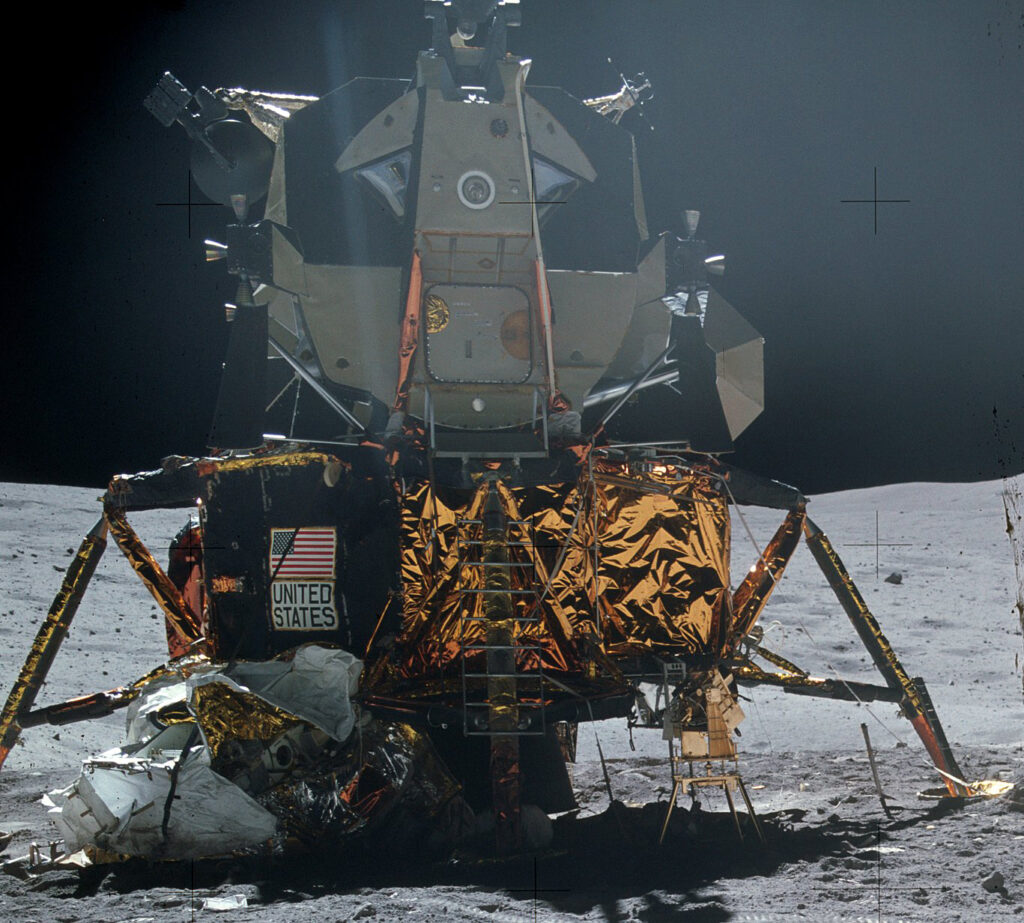
Apollo Lunar Module is a lander developed by National Aeronautics and Space Administration.
Mission profile: Landing on the Moon, Rendezvous in lunar orbit
The Apollo Lunar Module was the lunar lander spacecraft that was flown between lunar orbit and the Moon's surface during the United States' Apollo program. It was the first crewed spacecraft to operate exclusively in the airless vacuum of space, and was the first crewed vehicle to land anywhere beyond Earth.
Spacecraft Specifications & Launch Record
| Height | 7.04 m |
|---|---|
| Diameter | 4.22 m |
| Human Rated | Yes |
| Maiden Flight | 1/22/1968 |
| Crew Capacity | 2 |
| Spacecraft Flown | 10 |
| Total Launches | 16 |
| Successful Launches | 16 |
| Attempted Landings | 6 |
| Successful Landings | 6 |
| Fastest Turnaround | 21 hrs 36 min 20 sec |
History of the Apollo Lunar Module
First flown in 1969, the LM achieved its historic moment on July 20th, 1969, when the "Eagle" landed on the Moon, carrying the first humans to walk on its surface.
National Aeronautics and Space Administration Space Agency
The National Aeronautics and Space Administration is an independent agency of the executive branch of the United States federal government responsible for the civilian space program, as well as aeronautics and aerospace research. NASA have many launch facilities but most are inactive. The most commonly used pad will be LC-39B at Kennedy Space Center in Florida.