
Starship Prototype (SpaceX)
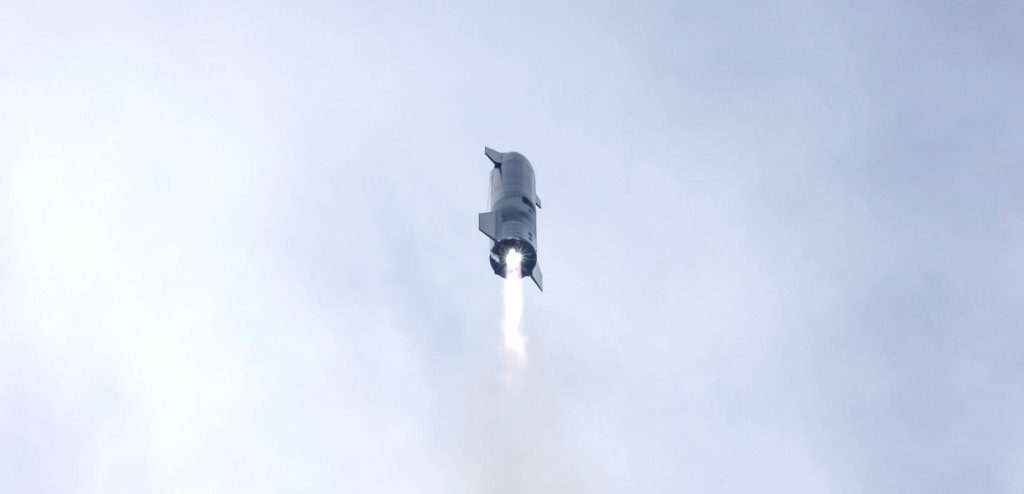
The Starship Prototype is a reusable, inactive launch vehicle manufactured by SpaceX (established in 2002). It undertook its inaugural launch on 07/26/2019.
Prototype of SpaceX's Starship, a fully reusable second stage and space vehicle.
Starship Prototype Specifications
| Variant | Prototype |
|---|---|
| Length | 50 m |
| Diameter | 9 m |
| Stages | 1 |
| Launch Mass | 45 T |
Starship Prototype Launch Record
| Total Launches | 9 |
|---|---|
| Successful Launches | 6 |
| Failed Launches | 3 |
| Consecutive Successful Launches | 1 |
Starship Prototype Landing Record
| Attempted Landings | 9 |
|---|---|
| Successful Landings | 5 |
| Failed Landings | 4 |
| Consecutive Successful Landings | 1 |
| Fastest Turnaround | 26 days 13 hrs 45 min |
Manufacturer
CEO: Elon Musk
Space Exploration Technologies Corp., known as SpaceX, is an American aerospace manufacturer and space transport services company headquartered in Hawthorne, California. It was founded in 2002 by entrepreneur Elon Musk with the goal of reducing space transportation costs and enabling the colonization of Mars. SpaceX operates from many pads, on the East Coast of the US they operate from SLC-40 at Cape Canaveral Space Force Station and historic LC-39A at Kennedy Space Center. They also operate from SLC-4E at Vandenberg Space Force Base, California, usually for polar launches. Another launch site is being developed at Boca Chica, Texas.
Program
The SpaceX Starship is a fully reusable super heavy-lift launch vehicle under development by SpaceX since 2012, as a self-funded private spaceflight project. The second stage of the Starship — is designed as a long-duration cargo and passenger-carrying spacecraft. It is expected to be initially used without any booster stage at all, as part of an extensive development program to prove out launch-and-landing and iterate on a variety of design details, particularly with respect to the vehicle's atmospheric reentry.