Discover the Revolution of Global Internet Access: An Overview of SpaceX’s Starlink Mission
The internet has become an essential part of modern life, yet millions of people worldwide still lack reliable access to high-speed connectivity. The SpaceX Starlink Mission was created to address this challenge by delivering satellite-based broadband internet to even the most remote regions of the planet.
Founded by Elon Musk, SpaceX aims to revolutionize global communications through Starlink, a massive constellation of satellites in low Earth orbit (LEO). While companies like Amazon are developing competing systems such as Amazon Leo, the SpaceX Starlink mission has already taken a commanding lead in deployment and availability.
What is the SpaceX Starlink Mission?
The SpaceX Starlink Mission is a satellite internet program designed to provide fast, low-latency broadband coverage worldwide. Unlike traditional satellite internet systems that rely on a few large geostationary satellites positioned tens of thousands of kilometers above Earth, Starlink operates using thousands of smaller satellites orbiting much closer to the planet.
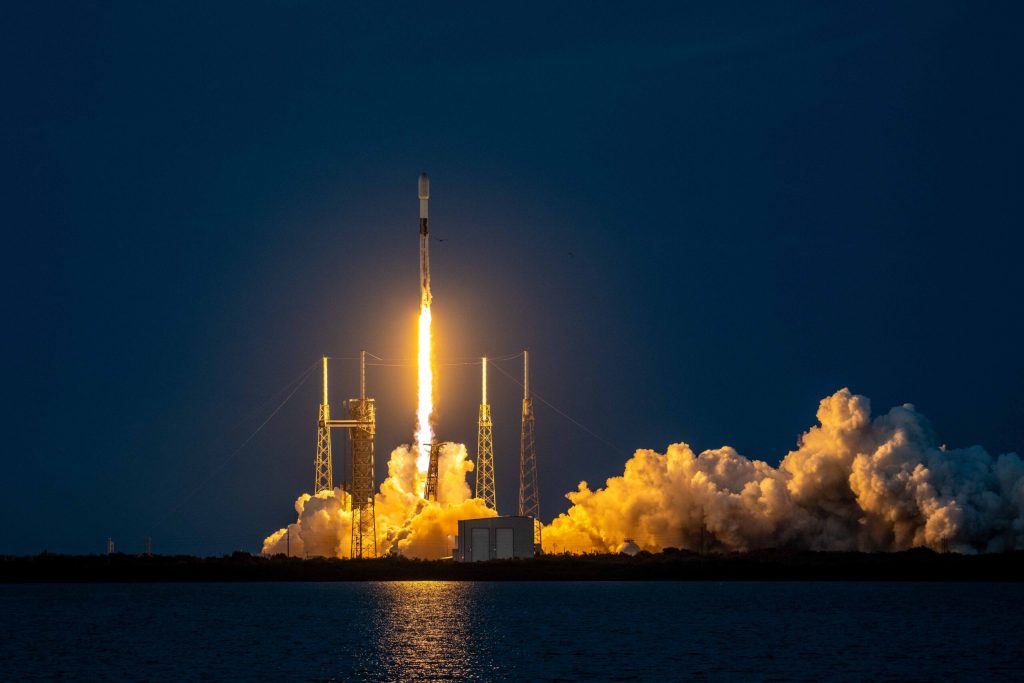
Starlink satellites are launched frequently—often multiple times per month—aboard Falcon 9 rockets. The first Starlink launch occurred in May 2019, and as of early 2025, nearly 7,000 satellites are already in orbit, forming the largest satellite constellation ever deployed.
Users connect to the SpaceX Starlink Mission through a compact satellite dish, commonly referred to as a user terminal. These terminals can be installed on rooftops, vehicles, boats, aircraft, and RVs, allowing flexible and mobile internet access across the globe.
How the SpaceX Starlink Mission Works
The technology behind the mission is what sets it apart from traditional satellite internet providers. Starlink satellites orbit Earth at approximately 550 kilometers, compared to geostationary satellites that orbit at roughly 35,000 kilometers. This dramatically shorter distance reduces signal travel time, resulting in significantly lower latency and faster speeds.
In addition to their orbital altitude, satellites are equipped with laser-based inter-satellite links, allowing data to be transferred directly between satellites without relying solely on ground stations. This feature is especially valuable in remote and underserved regions with limited terrestrial infrastructure.
Advanced phased-array antennas onboard the satellites and user terminals dynamically steer signals, optimizing connectivity and improving performance across the Starlink network.
The Vision Behind the SpaceX Starlink Mission
At its core, the SpaceX Starlink mission seeks to close the global digital divide. Rural and remote communities often lack reliable internet due to the high cost of laying fiber-optic cables or building cell towers. Starlink eliminates these barriers by providing coverage anywhere with a clear view of the sky.
The mission has the potential to transform industries such as education, healthcare, aviation, and disaster response. Remote learning platforms become accessible to underserved regions, while telemedicine enables healthcare providers to reach patients in isolated locations.
In aviation and maritime operations, Starlink offers constant high-speed connectivity, improving navigation, safety, and communication. During natural disasters, the SpaceX Starlink mission has already demonstrated its value by restoring internet access to emergency responders and affected communities.

The Future of the SpaceX Starlink Mission
SpaceX plans to continue expanding the mission, with long-term goals of deploying up to 42,000 satellites. Ongoing improvements in satellite design, network management, and launch cadence are expected to enhance speeds, reduce latency, and lower costs.
The SpaceX Starlink mission is also moving toward direct-to-smartphone connectivity, potentially eliminating the need for external user terminals. Recent smartphone updates have already introduced emergency satellite messaging, with full broadband connectivity expected in future iterations.
Starlink is also becoming increasingly important for government, military, and defense applications, where secure, resilient communication networks are critical.

Challenges Facing the SpaceX Starlink Mission
Despite its promise, the mission faces several challenges. Regulatory approval varies by country, requiring negotiations with governments before service can be offered. These regulatory hurdles can slow expansion into certain regions.
Cost is another consideration. While subscription prices have decreased over time, the upfront cost of Starlink hardware may remain prohibitive for some users in lower-income regions.
Astronomical interference has also raised concerns within the scientific community. SpaceX has responded by implementing darker satellite coatings and modified orientations to reduce reflectivity, though the issue remains under active discussion.
Finally, the growing number of satellites in low Earth orbit raises questions about space debris and long-term orbital sustainability. SpaceX employs autonomous collision avoidance systems and controlled deorbiting procedures to reduce risk, but responsible space management remains a global concern.
A Game-Changer in Global Connectivity
The SpaceX Starlink mission represents one of the most ambitious technological efforts of the modern era. By leveraging reusable rockets and advanced satellite technology, SpaceX is reshaping how the world connects to the internet.
From enabling education and healthcare in remote regions to supporting emergency response and global communications, the impact of the SpaceX Starlink mission is already being felt worldwide. As the constellation continues to expand, Starlink moves closer to its ultimate goal: making high-speed internet universally accessible.
Interested in seeing the SpaceX Starlink mission in action? Check the SpaceX launch schedule to watch an upcoming Starlink launch live.
FAQs About the SpaceX Starlink Mission
What is the SpaceX Starlink mission?
The mission is a satellite internet project designed to provide global broadband coverage using thousands of satellites in low Earth orbit.
How does Starlink differ from traditional satellite internet?
Starlink satellites orbit much closer to Earth, resulting in lower latency and faster speeds compared to traditional geostationary satellites.
How many SpaceX Starlink satellites are in orbit?
As of early 2025, nearly 7,000 Starlink satellites are operational, with plans for significant expansion.
Can Starlink work in remote areas?
Yes, the mission is specifically designed to serve rural and remote regions with limited infrastructure.
Does Starlink contribute to space debris?
SpaceX uses autonomous collision avoidance and controlled deorbiting to minimize debris risks, though long-term sustainability remains a concern.
Want to witness a Starlink launch firsthand? Check the SpaceX launch schedule for dates and times.
