Support Us On Patreon

Join our community of space enthusiasts for just $3/month and enjoy an ad-free experience across our app and website. Your support helps us deliver the best rocket launch tracking experience in the galaxy! 🚀

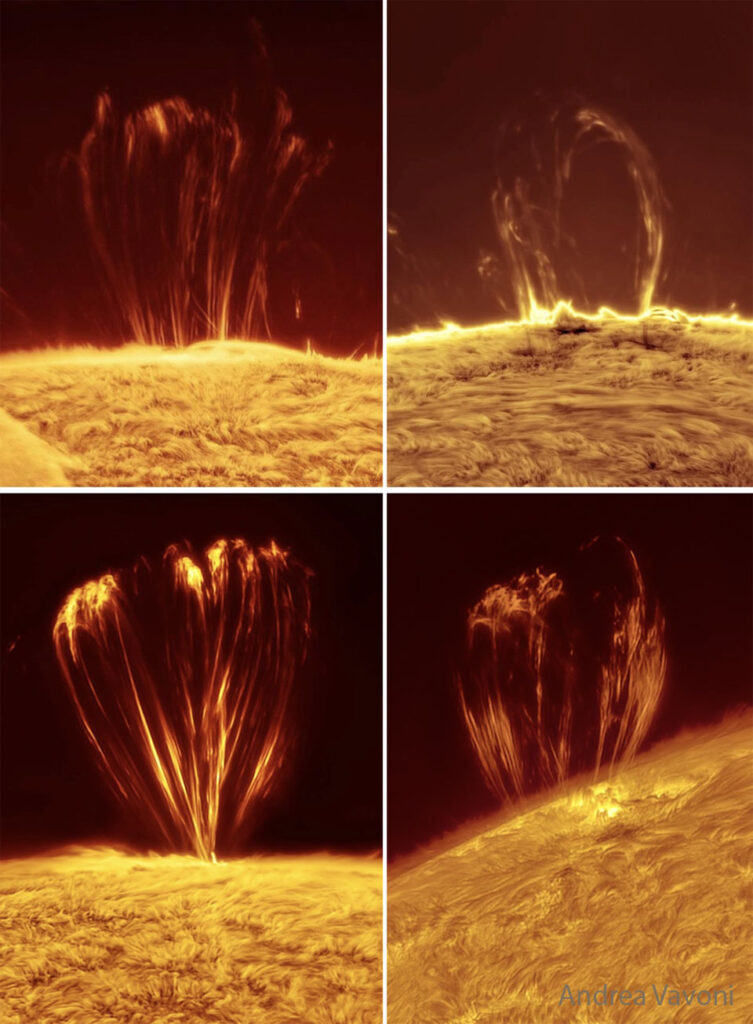
Coronal Loops on the Sun

Copyright: Andrea Vanoni Our Sun frequently erupts in loops. Hot solar plasma jumps off the Sun’s surface into prominences, with the most common type of prominence being a simple loop. The loop shape originates from the Sun’s magnetic field, which is traced by spiraling electrons and protons. Many loops into the Sun’s lower corona are […]

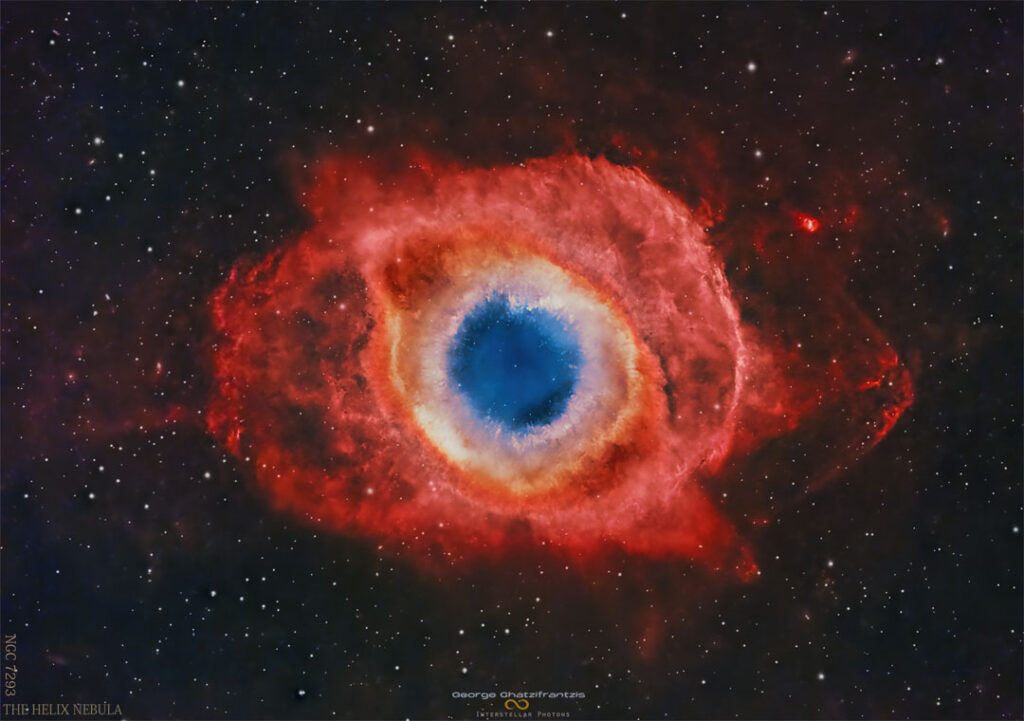
A Helix Nebula Deep Field

Copyright: George Chatzifrantzis Is the Helix Nebula looking at you? No, not in any biological sense, but it does look quite like an eye. The Helix Nebula is so named because it also appears that you are looking down the axis of a helix. In actuality, it is now understood to have a surprisingly complex […]

Collision at Asteroid Dimorphos

Why was this collision so strange? In 2022, to develop Earth-saving technology, NASA deliberately crashed the DART spacecraft into the asteroid moonlet Dimorphos. The hope was that this collision would alter the trajectory of Dimorphos around its parent asteroid Didymos and so demonstrate that similar collisions could, in theory, save the Earth from being hit […]

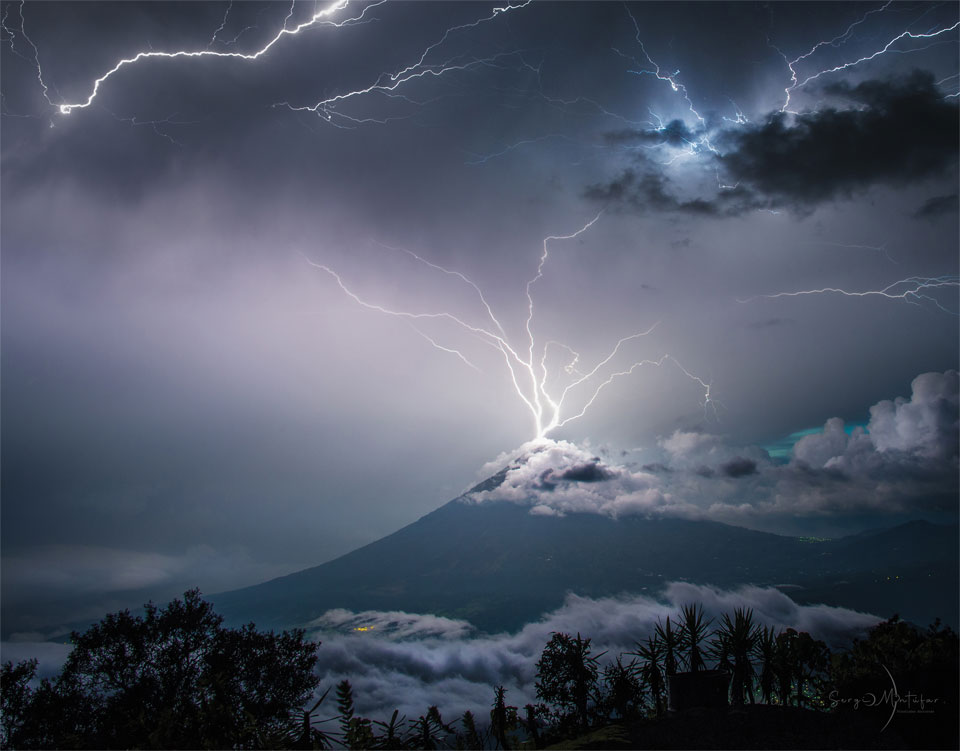
Lightning over the Volcano of Water

Have you ever watched a lightning storm in awe? You’re not alone. Details of what causes lightning are still being researched, but it is known that inside some clouds, internal updrafts cause collisions between ice and snow that slowly separate charges between cloud tops and bottoms. The rapid electrical discharges that are lightning soon result. […]

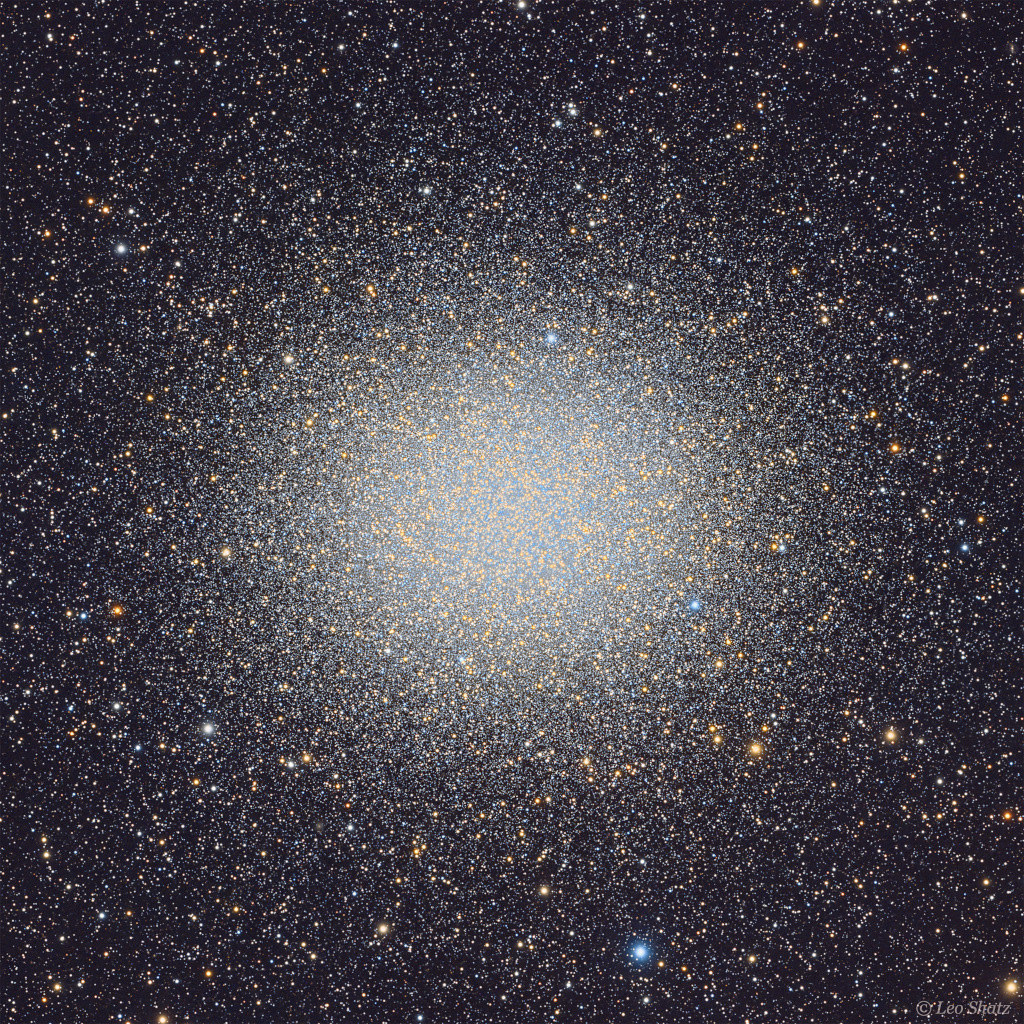
Globular Cluster Omega Centauri

Copyright: Leo Shatz Globular star cluster Omega Centauri packs about 10 million stars much older than the Sun into a volume some 150 light-years in diameter. Also known as NGC 5139, at a distance of 15,000 light-years it’s the largest and brightest of 200 or so known globular clusters that roam the halo of our […]

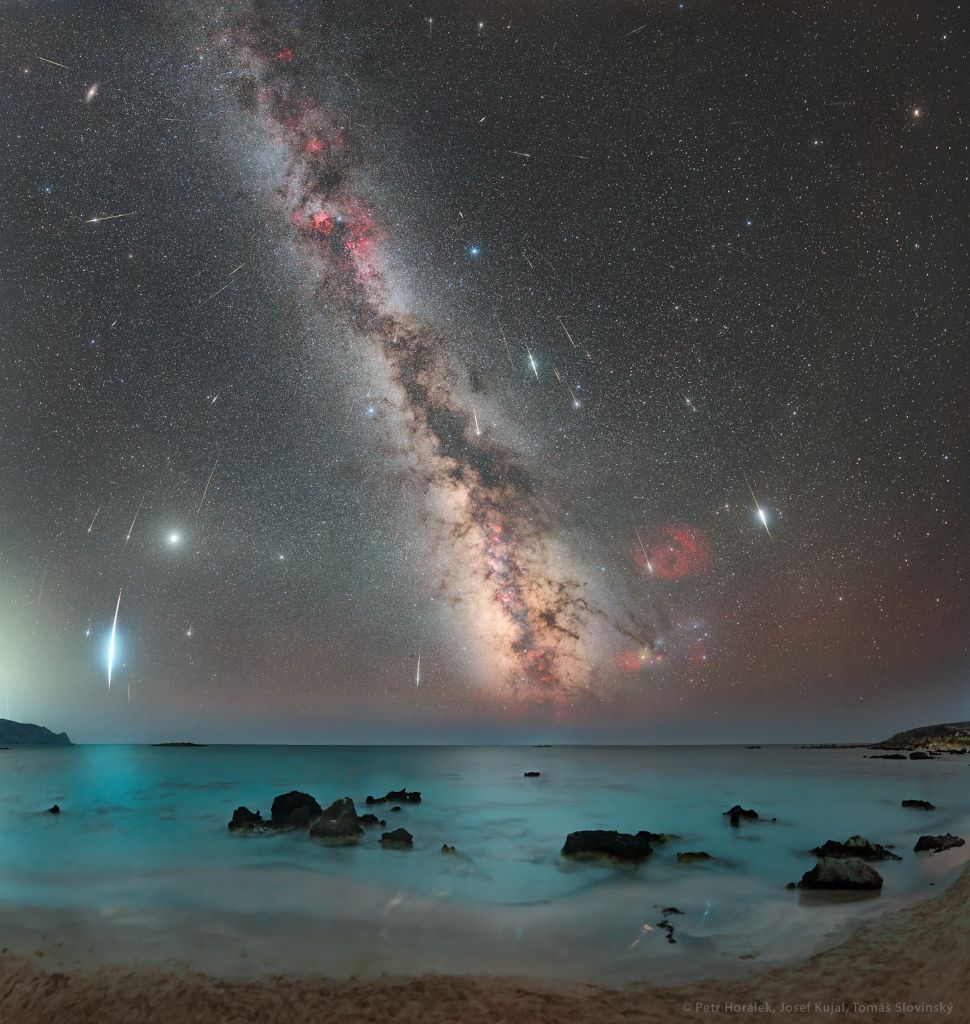
Twelve Years of Kappa Cygnids

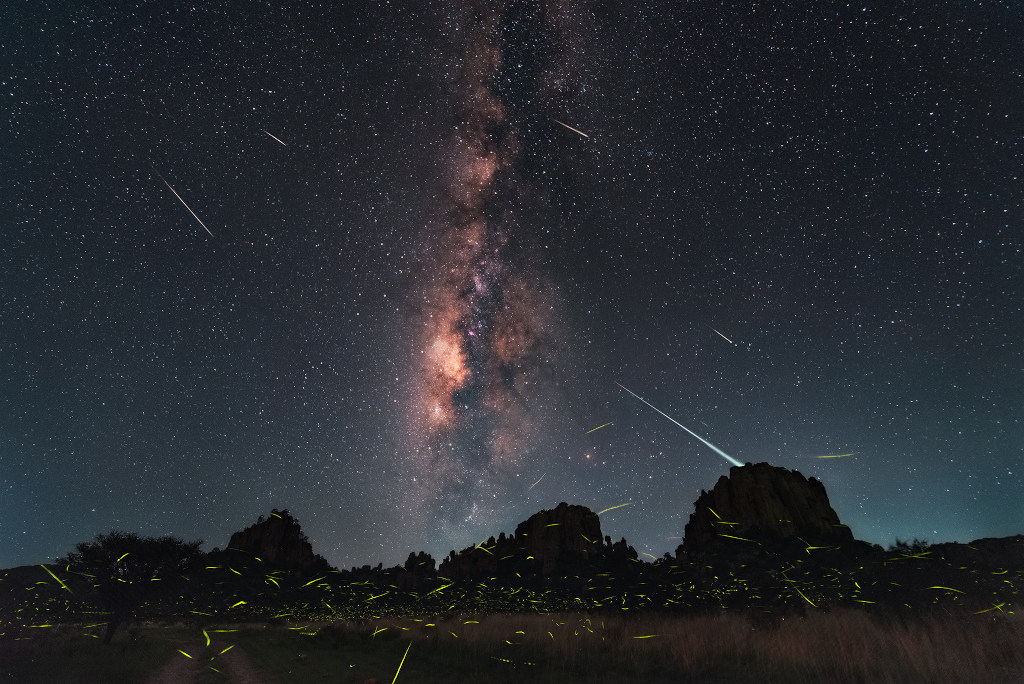
Copyright: Petr Horálek Meteors from the Kappa Cygnid meteor shower are captured in this time-lapse composite skyscape. The minor meteor shower, with a radiant not far from its eponymous star Kappa Cygni, peaks in mid-August, almost at the same time as the much better-known and better-observed Perseid meteor shower. But, seen to have a peak […]

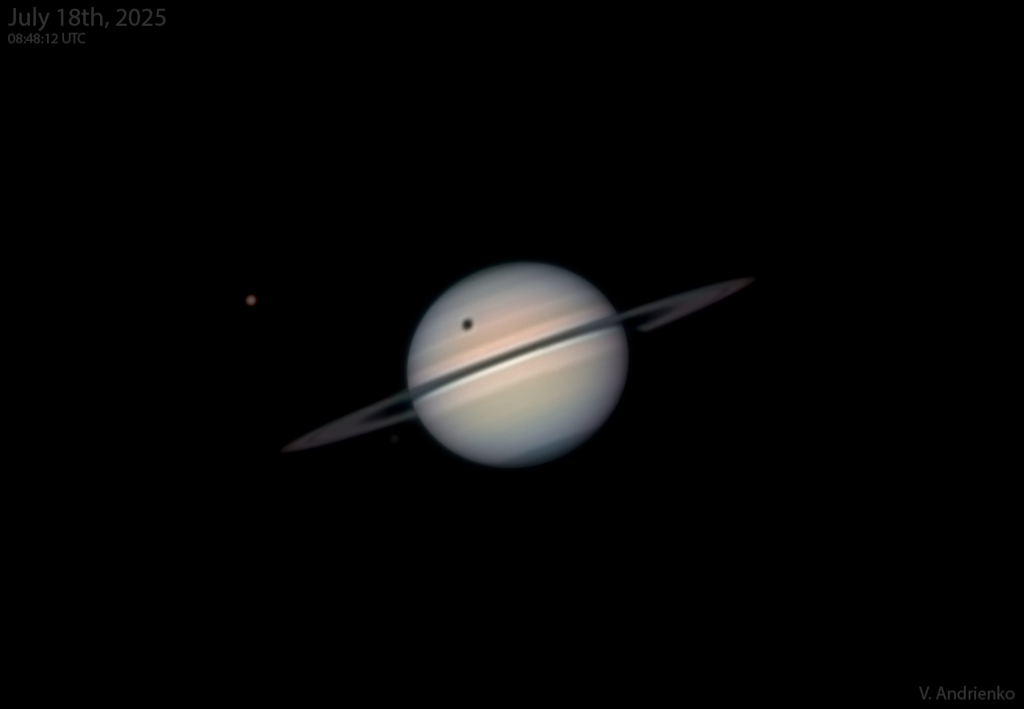
Titan Shadow Transit

Copyright: Every 15 years or so very 15 years or so, Saturn’s rings are tilted edge-on to our line of sight. As the bright, beautiful ring system grows narrower and fainter it becomes increasingly difficult to see for denizens of planet Earth. But it does provide the opportunity to watch transits of Saturn’s moons and […]

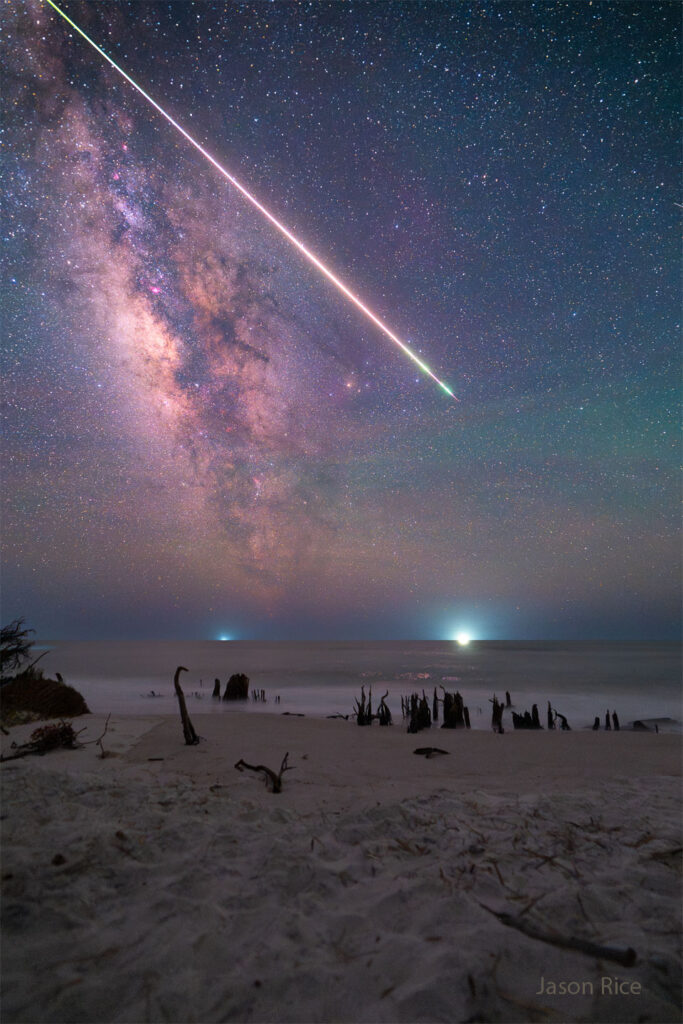
Fireball over Cape San Blas

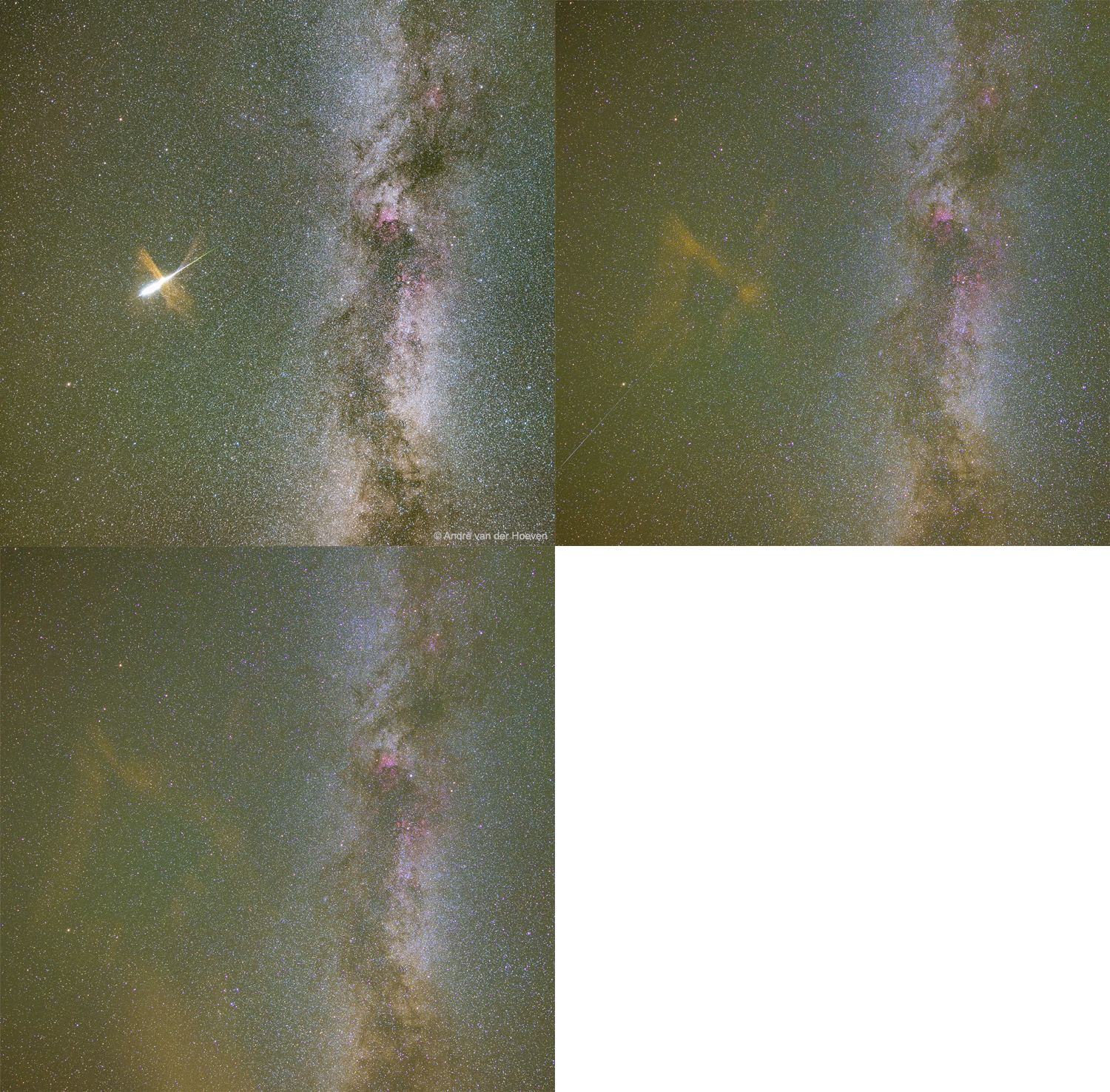
Copyright: Jason Rice Have you ever seen a fireball? In astronomy, a fireball is a very bright meteor — one at least as bright as Venus and possibly brighter than even a full Moon. Fireballs are rare — if you see one you are likely to remember it for your whole life. Physically, a fireball […]

A Double Detonation Supernova

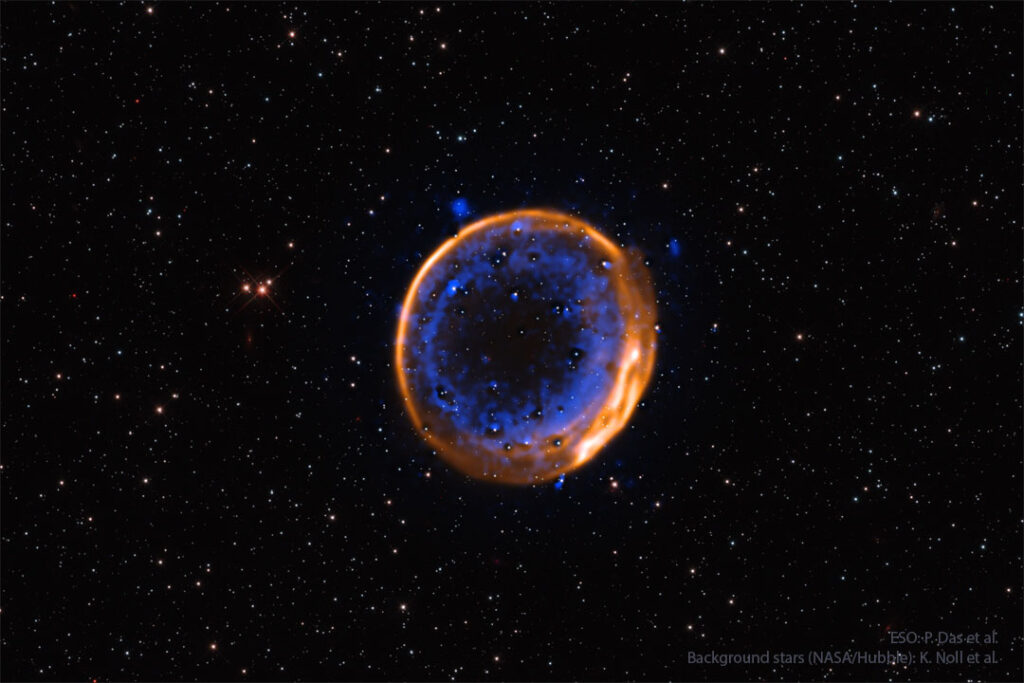
Can some supernovas explode twice? Yes, when the first explosion acts like a detonator for the second. This is a leading hypothesis for the cause of supernova remnant (SNR) 0509-67.5. In this two-star system, gravity causes the larger and fluffier star to give up mass to a smaller and denser white dwarf companion. Eventually the […]

Cat’s Paw Nebula from Webb Space Telescope

Nebulas are perhaps as famous for being identified with familiar shapes as perhaps cats are for getting into trouble. Still, no known cat could have created the vast Cat’s Paw Nebula visible toward the constellation of the Scorpion (Scorpius). At 5,700 light years distant, Cat’s Paw is an emission nebula within a larger molecular cloud. […]

Lunar Nearside

About 1,300 images from the Lunar Reconnaissance Orbiter spacecraft’s wide angle camera were used to compose this spectacular view of a familiar face – the lunar nearside. But why is there a lunar nearside? The Moon rotates on its axis and orbits the Earth at the same rate, about once every 28 days. Tidally locked […]

Messier 6

Copyright: Xinran Li The sixth object in Charles Messier’s famous catalog of things which are not comets, Messier 6 is a galactic or open star cluster. A gathering of 100 stars or so, all around 100 million years young, M6 lies some 1,600 light-years away toward the central Milky Way in the constellation Scorpius. Also […]

ISS Meets Saturn

Copyright: A.J. Smadi This month, bright planet Saturn rises in evening skies, its rings oriented nearly edge-on when viewed from planet Earth. And in the early morning hours on July 6, it posed very briefly with the International Space Station when viewed from a location in Federal Way, Washington, USA. This well-planned image, a stack […]

3I/ATLAS

Discovered on July 1 with the NASA-funded ATLAS (Asteroid Terrestrial-impact Last Alert, System) survey telescope in Rio Hurtado, Chile, 3I/ATLAS is so designated as the third known interstellar object to pass through our Solar System It follows 1I/ʻOumuamua in 2017 and the comet 2I/Borisov in 2019. Also known as C/2025 N1, 3I/ATLAS is clearly a […]

The Rosette Nebula from DECam

Would the Rosette Nebula by any other name look as sweet? The bland New General Catalog designation of NGC 2237 doesn’t appear to diminish the appearance of this flowery emission nebula, as captured by the Dark Energy Camera (DECam) on the Blanco 4-meter telescope at the NSF’s Cerro Tololo Inter-American Observatory in Chile. Inside the […]