
Long March 3B (China Aerospace Science and Technology Corporation)
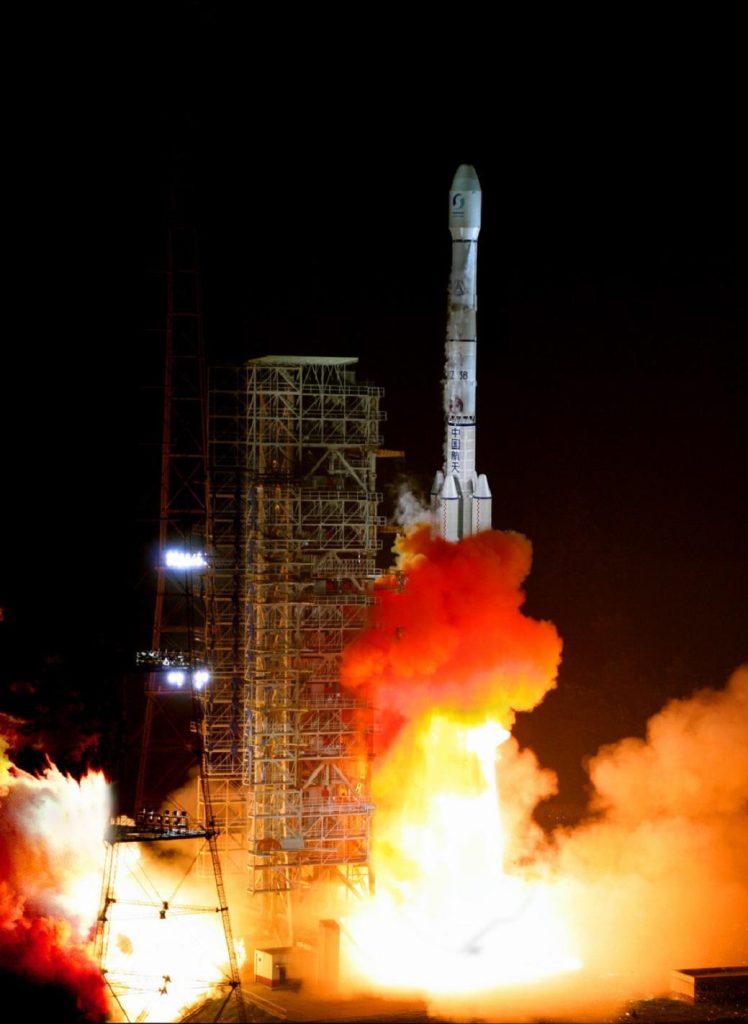
The Long March 3B is a non-reusable, active launch vehicle manufactured by China Aerospace Science and Technology Corporation (established in 1999). It undertook its inaugural launch on 02/14/1996.
The Long March 3B is a Chinese orbital carrier rocket. Introduced in 1996, it is launched from Launch Area 2 and 3 at the Xichang Satellite Launch Center in Sichuan. A three-stage rocket with four strap-on liquid rocket boosters, it is currently the most powerful member of the Long March rocket family and the heaviest of the Long March 3 rocket family, and is mainly used to place communications satellites into geosynchronous orbits.
Long March 3B Specifications
| Variant | B |
|---|---|
| Length | 54.8 m |
| Diameter | 3.35 m |
| Stages | 3 |
| Launch Mass | 426 T |
| Takeoff Thrust | 5923 kN |
| LEO Capacity | 11500 kg |
| GTO Capacity | 5100 kg |
| GEO Capacity | 2000 kg |
| Launch Cost | $70,000,000 |
Long March 3B Launch Record
| Total Launches | 24 |
|---|---|
| Successful Launches | 21 |
| Failed Launches | 3 |
| Consecutive Successful Launches | 3 |
Manufacturer
Chairman & President: Lei Fanpei
The China Aerospace Science and Technology Corporation (CASC) is the main contractor for the Chinese space program. It is state-owned and has a number of subordinate entities which design, develop and manufacture a range of spacecraft, launch vehicles, strategic and tactical missile systems, and ground equipment. It was officially established in July 1999 as part of a Chinese government reform drive, having previously been one part of the former China Aerospace Corporation. Various incarnations of the program date back to 1956.