SpaceX (SpX)
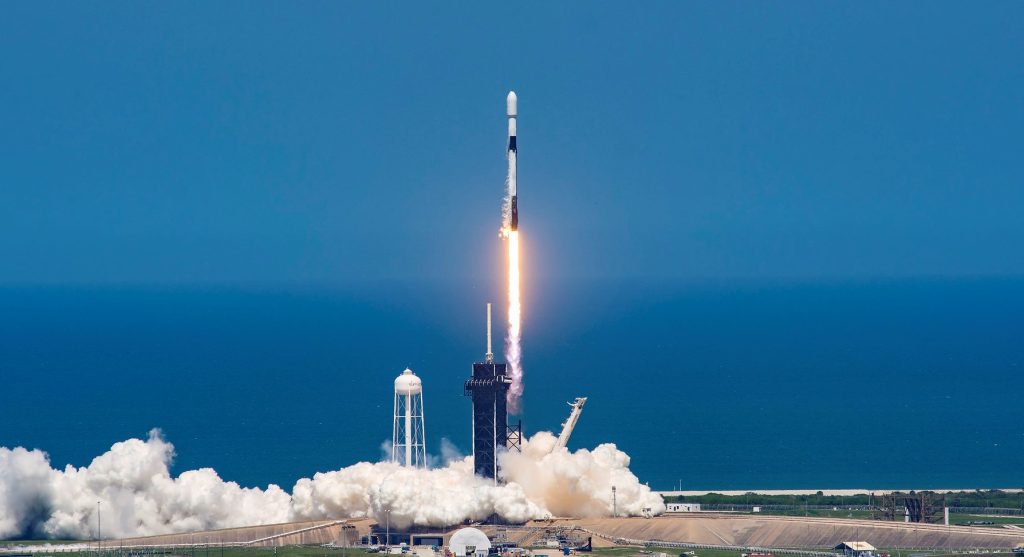

SpaceX is a commercial space agency, led by CEO: Elon Musk, established in 2002, operating out of United States of America.
Space Exploration Technologies Corp., known as SpaceX, is an American aerospace manufacturer and space transport services company headquartered in Hawthorne, California. It was founded in 2002 by entrepreneur Elon Musk with the goal of reducing space transportation costs and enabling the colonization of Mars. SpaceX operates from many pads, on the East Coast of the US they operate from SLC-40 at Cape Canaveral Space Force Station and historic LC-39A at Kennedy Space Center. They also operate from SLC-4E at Vandenberg Space Force Base, California, usually for polar launches. Another launch site is being developed at Boca Chica, Texas.
SpaceX Launch & Landing Record
| Total Launches | 735 |
|---|---|
| Successful Launches | 720 |
| Failed Launches | 15 |
| Pending Launches | 131 |
| Consecutive Successful Launches | 220 |
| Attempted Booster Landings | 708 |
| Successful Booster Landings | 680 |
| Failed Booster Landings | 29 |
| Consecutive Successful Landings | 29 |
SpaceX Launchers
The Falcon 1 was the first launch vehicle developed and manufactured by SpaceX in 2006. It is an expendable, two stage rocket where each stage is powered by a single LOX/RP1 engine.
Falcon 9 is a two-stage rocket designed and manufactured by SpaceX for the reliable and safe transport of satellites and the Dragon spacecraft into orbit. The Block 5 variant is the fifth major interval aimed at improving upon the ability for rapid reusability.
Falcon 9 v1.1 is a significantly redesigned version of the its predecessor, including a higher payload capacity. This version arranges the engines in a structural form SpaceX calls an Octaweb.
The Falcon 9 v1.0 first stage was used on the first five Falcon 9 launches, and powered by nine SpaceX Merlin 1C rocket engines arranged in a 3x3 pattern.
The Full Thrust variants first stage includes all systems necessary for an operational re-use of stages while the second stage is operated as an expendable rocket stage.
The Full Thrust variants first stage includes all systems necessary for an operational re-use of stages while the second stage is operated as an expendable rocket stage.
The Falcon Heavy is a variant of the Falcon 9 full thrust launch vehicle and consists of a standard Falcon 9 rocket core, with two additional boosters derived from the Falcon 9 first stage.
Third development version of the Starship reusable two-stage super heavy-lift launch vehicle.
First development version of the Starship reusable two-stage super heavy-lift launch vehicle.
Starship (unknown version)
Second development version of the Starship reusable two-stage super heavy-lift launch vehicle.
Prototype of SpaceX's Starship, a fully reusable second stage and space vehicle.
Prototype of SpaceX's Super Heavy, a fully reusable first stage for the Starship space vehicle.
SpaceX Spacecraft
Cargo Dragon 2 is an updated version of the original Dragon spaceship designed to service the International Space Station with first flights conducted in 2020. In contrast to Dragon 1 it docks to the International Space Station instead of being berthed by the Canada Arm.
Cargo Dragon 2 is a autonomous spaceship capable of bringing science to and from the International Space Station with large pressurized and un-pressurized sections to support a variety of missions.
Flight Life: Able to fly for up to one week of free flight or two years docked.
Crew Dragon 2 is a spacecraft developed by SpaceX, an American private space transportation company based in Hawthorne, California. Dragon is launched into space by the SpaceX Falcon 9 two-stage-to-orbit launch vehicle. It is one of two American Spacecraft being develeoped capable of lifting American Astronauts to the International Space Station. The first crewed flight, launched on 30 May 2020 on a Falcon 9 rocket, and carried NASA astronauts Douglas Hurley and Robert Behnken to the International Space Station in the first crewed orbital spaceflight launched from the US since the final Space Shuttle mission in 2011, and the first ever operated by a commercial provider.
Crew Dragon 2 is capable of lifting four astronauts, or a combination of crew and cargo to and from low Earth orbit. Its heat shield is designed to withstand Earth re-entry velocities from Lunar and Martian spaceflights.
Flight Life: Able to fly for up to one week of free flight or two years docked.
Dragon, also known as Dragon 1 or Cargo Dragon, was a class of fourteen partially reusable cargo spacecraft developed by SpaceX, an American private space transportation company. It flew 23 missions between 2010 and 2020. During its maiden flight in December 2010, Dragon became the first commercially built and operated spacecraft to be recovered successfully from orbit.
The Dragon spacecraft consists of a nose-cone cap, a conventional blunt-cone ballistic capsule, and an unpressurized cargo-carrier trunk equipped with two solar arrays. Dragon was launched into orbit by the company's Falcon 9 launch vehicle to resupply the International Space Station (ISS).
Flight Life: One week free flight, up to two years while berthed to the International Space Station.
The Starship second stage was testing during a number of low and high altitude suborbital flights before the first orbital launch attempt.
First-generation second stage of the two-stage Starship super heavy-lift launch vehicle.
Flight Life: Never used for orbital flights.
The second-generation Starship upper stage was introduced on flight 7.
Second-generation second stage of the two-stage Starship super heavy-lift launch vehicle. It features a thinner forward flap design, flaps that are positioned more leeward, a 25% increase in propellant capacity, integrated vented interstage, redesigned avionics, two raceways, and an increase in thrust.
Flight Life: Never used for orbital flights.
The third-generation Starship upper stage will be introduced on flight 12.
Third-generation second stage of the two-stage Starship super heavy-lift launch vehicle.
Flight Life: Unknown at this stage
Elon Musk's Tesla Roadster is an electric sports car that served as the dummy payload for the February 2018 Falcon Heavy test flight and became an artificial satellite of the Sun. "Starman", a mannequin dressed in a spacesuit, occupies the driver's seat. The car and rocket are products of Tesla and SpaceX, respectively, both companies founded by Elon Musk. The 2008-model Roadster was previously used by Musk for commuting to work, and is the only production car in space.
The car, mounted on the rocket's second stage, acquired enough velocity to escape Earth's gravity and enter an elliptical heliocentric orbit crossing the orbit of Mars. The orbit reaches a maximum distance from the Sun at aphelion of 1.66 astronomical units (au). During the early portion of the voyage outside the Earth's atmosphere, live video was transmitted back to the mission control center and live-streamed for slightly over four hours.
Flight Life: It is now on an heliocentric orbit with no planned return to Earth.